



How to handle subcontractors in Business Central?
“`html
Subcontractor handling in Business Central lets you send a production operation to a vendor instead of doing it yourself. You set up a work center as a subcontractor and add it to your routing, just like any other operation.
You are not buying an item or putting anything on stock. You are buying a resource that performs work for you, such as painting a bike as part of your production process.
You can define a waiting time on the routing line to account for delays, for example two days, using days as the unit of measure code.
You can also set a specific unit cost directly on the routing operation. This lets you specify the exact price for the subcontracted job on that particular routing, rather than relying only on the work center cost.
What subcontractor handling in Business Central does
Subcontractor handling is about letting a vendor perform operations on your routings when you use production. Instead of carrying out an operation yourself, you send it to a subcontractor who does the work for you.
The key point is that you are not buying items. You are buying a resource. The vendor performs a step in your process, and nothing goes onto stock as a separate purchased item. A good example is a painting operation: the vendor paints your bike as part of your routing, and that painting is simply one of the steps in producing the finished bike.
Adding a subcontractor to a routing
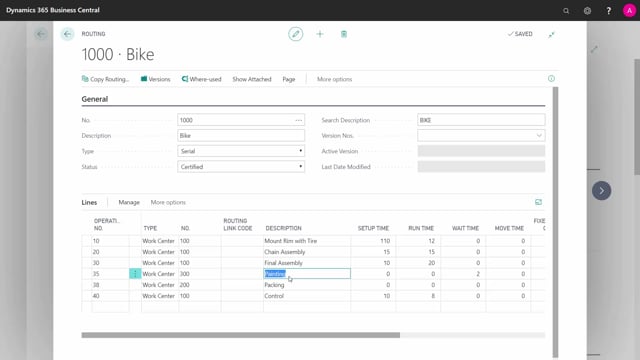
You use the subcontractor directly on your routings. In a routing for a bike, for example, the painting operation can be the step you want to send to a vendor. To make this work, you set up a work center as a subcontractor. In this example, work center number 300 is set up as the subcontractor.
Once that work center is in place, you assign it to the relevant operation in the routing. The setup of the work center itself is a separate topic, but the routing is where you decide which operations the subcontractor handles.
Setting waiting time on the operation
On the routing line you can define a waiting time to reflect the delay involved in sending work to a vendor. In this example the waiting time is two days, with days as the unit of measure code. This makes sure your production planning accounts for the time the operation spends with the subcontractor.
Setting a specific unit cost for the subcontracted operation
You can define a specific unit cost for the operation directly on the routing. This means the cost does not have to follow the work center alone. You can state that when your vendor paints this specific bike on this specific routing, this is the price for the painting job.
This gives you control over the cost of subcontracted work at the operation level, so each routing reflects the actual price you pay the vendor for that step.
Q&A
What is subcontractor handling in Business Central?
It is the ability to let a vendor perform an operation on your production routing instead of doing it yourself. You are buying a resource that performs work for you, not buying an item that goes onto stock.
How do you set up a subcontractor in a routing?
You set up a work center as a subcontractor, then assign that work center to the relevant operation on the routing. In the example, work center number 300 is set up as the subcontractor and added to the painting operation.
Can you account for delays when sending work to a subcontractor?
Yes. You define a waiting time on the routing line. In the example it is two days, using days as the unit of measure code, so your planning reflects the time the operation spends with the vendor.
How do you set the cost for a subcontracted operation?
You can define a specific unit cost directly on the routing operation. This means the cost does not have to follow the work center, so you can set the exact price the vendor charges for that specific job on that specific routing.
“`
Let’s see how it works in Business Central.
I want to use my subcontractor on the routing.
We look into the routings.
I will define the setup in other videos.
Looking in a routing for my bike, this painting operation could be sent to a vendor to perform the operation.
I’m not buying an item.
I’m not putting anything on stock.
They just paint my bike – as part of my process and routing.
Therefore, I have set up Work Center 300 as a subcontractor.
I’ll show this in later videos.
Scroll right, and I can see the defined waiting time.
I know it’s 2 days.
It’s the delay.
The unit of measure code is ‘days’, and further to the right, I can define a specific unit cost for that specific operation.
So, it’s not only following my Work Center.
I can define that if this vendor is painting this specific bike on this routing – this is the price for the job.
This way, I can use subcontractors that are actually vendors performing work for me.