


“`html
When you go live with Business Central, you should make a copy of your company first and run through the complete opening flow before posting to your live company. This lets you catch any errors before they end up in your production data.
The opening balances are entered manually, which means the numbers can be wrong even if the journals post without errors. You need to reconcile every area after posting to confirm the figures are correct.
After posting all opening journals, your chart of accounts should return to zero. If it does, your opening entries balance correctly and you are ready to start working in Business Central.
You reconcile inventory using the Inventory Valuation report, customers and vendors using the reconciliation reports, bank accounts through the bank account ledger entries, and VAT through the VAT Statement preview.
Why you should test the opening flow in a copy of your company
Before you do the final postings for your go-live in Business Central, make a copy of the company and run through the complete flow there. This way you confirm that everything is correct before you commit anything to your live company.
Start by checking that the company is clean. Go into your chart of accounts to make sure nobody has posted anything, so there are no entries. You should also check your item ledger entries, VAT entries and bank entries. When everything is clean, you are ready to test that the opening process works as expected.
Posting the opening journals
The opening entries are usually prepared in advance across all your journals, so the task is to post them in the right order. A practical tip: delete your opening journals once you are done, so you are not left with a lot of journals lying around for no reason.
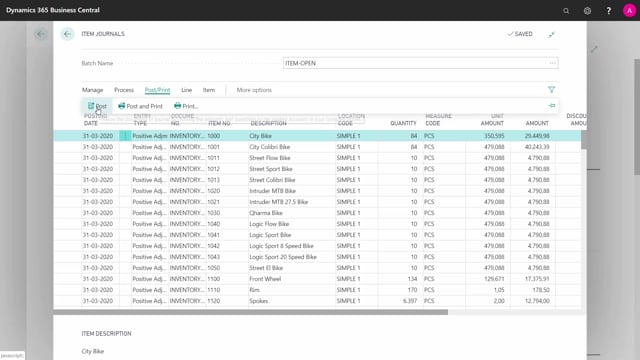
Start with the item journal. After posting, you can filter on net change being different from zero to follow what the journal actually did and confirm it created the inventory entries you expected.
Then move through the general journals one by one:
- Post the bank opening to create the bank entries.
- Post the customer openings.
- Post the inventory entries to set up your inventory.
- Post the VAT opening, which reverses your reverse charges.
- Post the vendor opening balance last.
Each of these journals brings the chart of accounts back toward zero. It is worth checking the GL balance after each step so you can spot a problem early instead of at the end.
When all the entries are posted and your chart of accounts shows zero, post your final general opening journal. At that point everything is posted and you can begin reconciling.
Reconciling inventory after the opening
Reconcile your items using the Inventory Valuation report with the opening date. You can preview the report and, if you do not want to remember all the figures, save it somewhere on the screen so you can compare against your source numbers.
In the example used here, the inventory breaks down as roughly 135,000 on finished goods, 116,000 on raw materials, 129,630 on resale items, and 37,000 on semi-finished goods, for a total of around 419,000. You then check these against the lines above to confirm they match.
Reconciling customers, vendors and bank accounts
The reason for reconciling each area is that the opening journal is entered manually. You could have entered any numbers you wanted, so you need to verify that everything is correct.
For customers, use the reconciliation report. It compares your customer ledger entries against the GL entry for customers. When the two figures match and there is no difference, the customer opening is correct.
For bank accounts, take each bank account and navigate into its balance. Confirm the balance from the bank account ledger entry matches what it should be. In the example, the first bank shows 2,296,344 and the second bank shows 135,000 in local currency. Check each bank account balance against your source figures.
Reconciling VAT through the VAT Statement
Reconcile VAT from the VAT Statement using the preview, which shows all your open VAT entries. In the example, sales VAT should be 30,366, acquisition tax 126.84, and the purchase deductions 8,125.
You then compare these figures against the chart of accounts in the VAT section. When everything matches, the VAT opening is correct.
Once inventory, customers, vendors, bank accounts and VAT all reconcile, your opening is verified. You can open Business Central and start working.
Q&A
Why should you make a copy of your company before going live in Business Central?
Making a copy lets you run through the complete opening flow and catch any errors before you commit the postings to your live company. The opening balances are entered manually, so testing in a copy protects your production data from wrong numbers.
How do you know your opening balances are correct after posting?
After posting all opening journals, your chart of accounts should return to zero. If it balances to zero, your opening entries are correct. You then reconcile each area separately to confirm the individual figures.
Why do you need to reconcile after posting the opening journals?
The opening journal is entered manually, which means you could have entered any numbers. Reconciling inventory, customers, vendors, bank accounts and VAT confirms that the entered figures are actually correct.
Which reports do you use to reconcile the opening in Business Central?
Use the Inventory Valuation report for items, the reconciliation reports for customers and vendors, the bank account ledger entries for bank balances, and the VAT Statement preview for VAT.
Should you keep your opening journals after posting?
No. Delete your opening journals once you are done so you are not left with a lot of journals lying around with no purpose.
“`