


When you go live with a new Business Central solution, you need to import your open customer ledger entries so you can apply payments against them later. The method is to post each entry with the customer on one side and the customer’s receivables account as the balancing account. This nets the general ledger to zero, so your open entries appear in the customer ledger without affecting the chart of accounts before you post your full opening balance.
Create a dedicated general journal batch for the opening entries. Set the document type to Invoice for normal entries and Credit Memo for credit entries, and enter the original posted document number so you can trace it back. Use the description field for the original sales order number, but remember the customer sees this text on bank statements.
Set the balancing account to the receivables account from the customer posting group. When the journal posts, the GL entries cancel out to zero on that account, while the open customer ledger entries are created with the correct amounts, ready to be applied when customers pay.
Why You Import Open Customer Ledger Entries Separately
When you migrate to Business Central, you want your open customer ledger entries available so you can apply them later when the customer pays. The strategy is straightforward: post the customer on one side and the customer’s own receivables account on the other side. This way the chart of accounts nets to zero, and you keep the option open to post a complete opening balance afterwards.
Before you start, check the chart of accounts to confirm there are no entries yet. Dive into the entries on the receivables account and verify nothing is posted there.
Setting Up the General Journal Batch
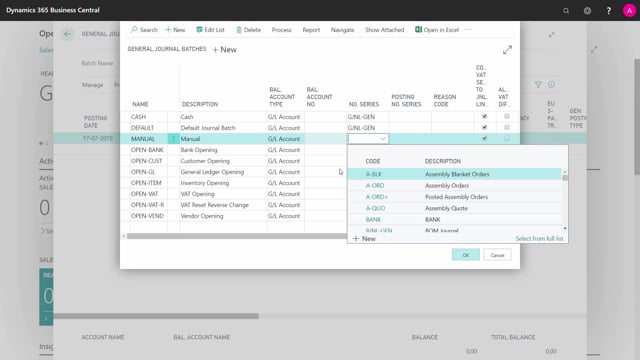
Go into the general journal and create a batch name specifically for this task. In the example, the batch is called “customer opening.” Using a dedicated batch keeps the opening entries separate and makes the process easier to manage.
In the batch setup, you are not forced to use a specific number series. If there is a number series, you can remove it so you can enter the document number manually. In this case, no number series is used.
Entering the Customer Lines
Fill in each line for your customers as follows:
- Document type: Set this to Invoice for a normal open customer ledger entry, or Credit Memo for a credit entry.
- Document number: Enter the posted sales invoice number from your old system, or whatever document number applies.
- Account type: Select Customer.
- Account number: Enter the customer number.
- Description: You can use this field for the original sales order number from the old system. That way you have both the original order number and the posted document number on the entry.
- Currency code: Enter the currency for the entry.
- Amount: Enter the amount for the open customer entry.
Be aware that the description field is the text that appears on the ledger entries, and it is also the information used on bank statements. The customer will actually see this description, so keep that in mind when you decide what to put there.
Handling Dimensions on Opening Entries
If you use dimensions, such as a project code, you have to enter them on each line as well. If you are combining several invoices into one customer ledger entry, the entry should be split per dimension, so the dimension values stay correct on the resulting entries.
Setting the Balancing Account to the Receivables Account
For the balancing account, you want the customer’s receivables account. Find it through the customer posting group, where the receivables account is defined. In this example, there is only one receivables account across all customer posting groups, so the same account is entered on every line.
Once all lines are filled in with the document type, customer, description, currency, amount, balance account, and project codes, the journal is ready to post.
Verifying the Result After Posting
After posting the journal, check the receivables account in the chart of accounts. Remove the filter and you will see all the GL entries on the same account, with the customer number as the balancing account. In the example, this is account 85-00-05, and its balance is zero, which is exactly what you want.
Then go into the customer ledger entries. You will see all the open customer ledger entries created with the correct amounts, exactly as expected. You now have your open customer entries in place, and the chart of accounts is still at zero, so you can post a complete opening balance later.
Q&A
How do I import open customer ledger entries when going live with Business Central?
Use a general journal. Post each entry with the customer on one side and the customer’s receivables account as the balancing account. This creates the open customer ledger entries while netting the general ledger to zero.
What document number should I use when importing open customer entries?
Enter the document number manually, using the posted sales invoice number from your old system. Set the document type to Invoice for normal entries and Credit Memo for credit entries.
Why should I create a dedicated journal batch for customer opening entries?
A dedicated batch, for example named “customer opening,” keeps the opening entries separate and makes the process easier to control. You can also remove the number series in the batch so you can enter document numbers manually.
What should I be aware of when using the description field on opening entries?
The description appears on the ledger entries and on bank statements, so the customer will see it. If you use it for the original sales order number, keep in mind it is visible externally.
How do I confirm the import worked correctly?
Check the receivables account in the chart of accounts. Its balance should be zero. Then check the customer ledger entries to confirm all open entries were created with the correct amounts.