
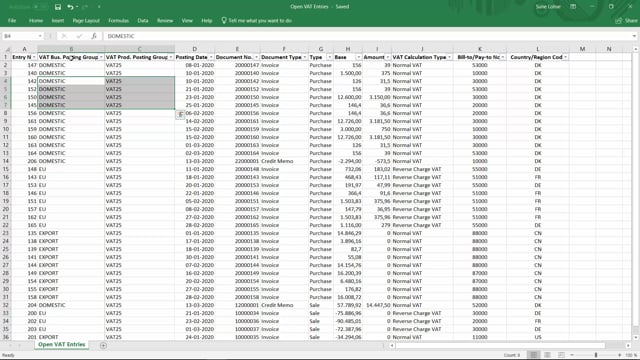


When you migrate to Business Central, you can import open VAT entries from your old system instead of settling all VAT before go-live. This article shows you how to create open VAT entries through a general journal while keeping your chart of accounts at zero, so you can post a full opening balance later.
You post the VAT entries by entering the base amount and the combination of VAT business posting group and VAT product posting group in a general journal. Business Central then calculates the VAT amount automatically.
You use the same VAT account as both the posting and balancing account on each line. This keeps the general ledger balance at zero while you create the VAT entries.
You need to handle reverse charge combinations separately. Combinations such as EU and VAT25 post the VAT to a different account than your sales and purchase accounts, which creates a deviation you must clear with a manual journal entry.
Why you might need to import open VAT entries
When customers go live with Business Central, the usual approach is to settle the VAT in the old system. This avoids carrying open VAT entries into the new system at all.
Sometimes that is not possible. In those cases you need the open VAT entries imported into the new system so you can settle them in Business Central later. The goal is to create those VAT entries and at the same time keep the chart of accounts clean, so you can post one full opening balance afterwards.
Preparing the open VAT entries from the old system
Start by listing your open VAT entries from the old system, for example in Excel. When you settle VAT, what matters is the combination of VAT business posting group and VAT product posting group.
You do not have to recreate every single entry. You can collapse all entries that share the same combination into one base amount per combination. Business Central calculates the VAT amount for you when you post.
If you only have the VAT amount and not the base amount, you can calculate it. For a VAT rate of 25%, multiply the VAT amount by five. For 12.5%, multiply by ten.
Finding the right VAT accounts in the VAT posting setup
Before posting, open the VAT posting setup to find the accounts you need. For each combination of VAT business posting group and VAT product posting group, you can see the sales VAT account and the purchase VAT account.
Pay attention to combinations that use reverse charge, such as EU and VAT25. For these, the reverse charge account is a different account than your normal sales and purchase accounts. This is the source of the deviation you need to clean up later.
Posting the VAT entries in a general journal
In a general journal, enter a document number for the opening, for example “VAT opening”. On each line, select the relevant sales VAT or purchase VAT account.
Set the general posting type to Sale for sales VAT lines and to Purchase for purchase VAT lines. Enter the base amount as the amount, then fill in the VAT business posting group and VAT product posting group on the right-hand side. Business Central calculates the VAT amount automatically.
Use the same VAT account as the balancing account on each line. This way the general ledger balance stays at zero while you create the open VAT entries, which keeps the chart of accounts clean for a single opening balance journal later.
Some lines will have a VAT amount of zero, for example a combination of Export and VAT25 where there is no VAT. You still want the open entry, because you have to settle all revenue-creating VAT, including the zero-amount lines.
Handling reverse charge and acquisition tax
Lines with combinations such as EU and VAT25 create reverse charge postings, which Business Central also records as acquisition tax. After posting the journal, check the chart of accounts and filter on net change different from zero.
You will see that the reverse charge has created amounts on the acquisition tax accounts. To keep a clean chart of accounts, zero these out by posting a manual general journal that moves the amount from one account to the other.
When you have done this, the chart of accounts is zero all the way through, and the VAT entries are recorded as open entries ready to be settled later.
Preparing everything for go-live
You can do all of this in advance as part of your go-live preparation. Create the journals for the VAT entries and for clearing the reverse charge deviations beforehand. When you reach the actual go-live, the journals are ready and you can post them in one go for a clean opening balance.
Q&A
Should I settle VAT in the old system or import open VAT entries into Business Central?
The usual approach is to settle the VAT in the old system before go-live, so you avoid carrying open VAT entries into Business Central. Import open VAT entries only when settling in the old system is not possible.
How do I create open VAT entries in Business Central?
Post them through a general journal. On each line, select the relevant VAT account, set the general posting type to Sale or Purchase, enter the base amount, and fill in the VAT business posting group and VAT product posting group. Business Central calculates the VAT amount automatically.
How do I keep the chart of accounts at zero while creating VAT entries?
Use the same VAT account as both the posting and balancing account on each journal line. The general ledger balance stays at zero, which lets you post one full opening balance journal later.
How do I calculate the base amount if I only have the VAT amount?
For a 25% VAT rate, multiply the VAT amount by five. For 12.5%, multiply by ten.
Why do I get amounts on the acquisition tax accounts after posting?
Reverse charge combinations, such as EU and VAT25, post VAT to a different account than your normal sales and purchase accounts, which Business Central records as acquisition tax. Clear these amounts with a manual general journal entry to get a clean chart of accounts.
Should I keep VAT entries with a zero VAT amount?
Yes. Combinations like Export and VAT25 have no VAT amount, but you still want the open entry because you have to settle all revenue-creating VAT.