


In Microsoft Dynamics 365 Business Central you can maintain several versions of a production BOM and a routing on the same item. Each version has its own starting date and certification status, and Business Central automatically picks the active version based on the date when you create a production order.
To create a new version, open the production BOM, go to Versions, and add a version code with a unit of measure code and a starting date. You can copy the lines from the standard BOM or from an existing version, adjust the components and quantities, and then certify the version. The version stays inactive until you certify it and its starting date is reached.
Always check which version you are looking at. The default view of a production BOM is not necessarily the active version, so the quantities you see on screen may differ from the ones Business Central uses when it explodes the BOM on a production order.
Working with versions of production BOMs and routings in Business Central
Business Central lets you work with different versions of both routings and production BOMs (bill of materials) on the same item. This is handled through version management, and it works the same way for production BOMs as it does for routings.
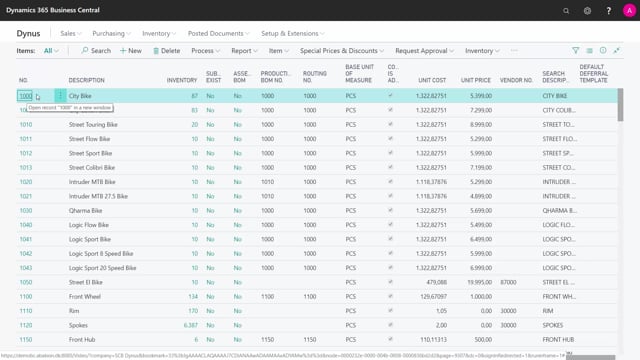
On an item card you can see the production BOM number and the routing number. In this example, item 1000 uses production BOM number 1000 and routing number 1000, and the same BOM and routing numbers are shared across several items. The version management functionality is identical on the BOM side and the routing side, so once you understand one, you understand both.
The default view is not always the active version
When you open a production BOM, what you see in the main view is not necessarily the active version. In the example, the BOM shows components such as a quantity of 1 on the first two lines, but the BOM has an active version A with different content.
This matters because when you create a new production order, Business Central uses the active version, not what you happen to see in the default view. If you want to see the version that will actually be used, go to Versions and open the active version.
In the active version A, the components are different. It includes a chain assembly and a Mudguard Front with a quantity of 2 instead. So you have to be aware that you are looking at the correct version, otherwise you draw conclusions from the wrong set of components and quantities.
How to create a new version of a production BOM
If you want a new version to take effect from a specific date, for example the 1st of July this year, you create it under Versions. The steps are:
- Create a version code. You define this yourself and can name it however you like.
- Set the unit of measure code, which comes from the unit of measure table.
- Set the starting date, for example the 1st of July.
- Copy the lines, either from the standard bill of material or from one of your existing versions. You select the source from a list, for example version A.
- Modify the bill of material lines as needed.
- Certify the version.
Certification is the step that activates the version. Until you certify it, the new version will not be used.
How Business Central selects the active version
Once a version is certified and its starting date is reached, it becomes the active version. After certifying version B with the changed quantities, the production order shows that the active version is now B.
The active version is controlled by the combination of the starting date and the status. If you change the status on version B so it is no longer certified, Business Central falls back to version A. The same logic applies on the routing side.
Q&A
Can you have multiple versions of a production BOM in Business Central?
Yes. You can maintain several versions of a production BOM, and the same applies to routings. Each version has its own version code, unit of measure code, starting date, and certification status.
How does Business Central decide which BOM version to use on a production order?
It uses the active version, which is determined by the combination of the starting date and the certification status. When you create a production order, Business Central picks the version that is certified and whose starting date has been reached.
Why does the production BOM I see not match what the production order uses?
The default view of a production BOM is not necessarily the active version. To see what will actually be used, go to Versions and open the active version, since its components and quantities can differ from the main view.
What do you need to do to activate a new BOM version?
You have to certify it. A new version stays inactive until you certify it and its starting date is reached. If you change the status so it is no longer certified, Business Central reverts to the previous active version.
Can you copy lines when creating a new BOM version?
Yes. When creating a new version you can copy the lines from the standard bill of material or from an existing version, then modify the lines before certifying.