
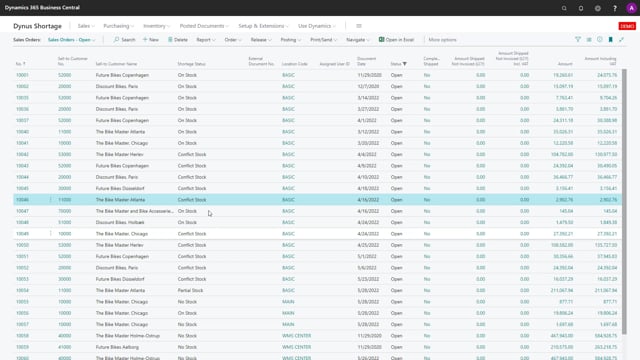


When you work with sales orders in Business Central, knowing whether you can actually ship what your customer ordered is critical. The shortage status functionality gives you a clear picture of stock availability directly on the order, so you can act before a delivery problem becomes a customer problem.
The shortage status accumulates from the order lines to the order header. The header always shows the worst shortage status among the lines. If just one line cannot be fully covered, the header reflects that.
You can calculate the shortage status either through a report or directly on the document. Once calculated, the status appears on each order line and on the order header.
How shortage status is calculated on sales orders
You can run the calculation in two ways. Either through the report, or directly on the order document itself. Once you trigger the calculation, the shortage status shows up in two places: on each individual order line, and on the order header.
The status on the line tells you the situation for that specific item. The status on the header gives you the overall picture for the whole order.
How the header reflects the worst status from the lines
The header does not show an average or a sum. It shows the worst shortage status found among the lines. The logic is simple: if any single line has a problem, the header flags it.
Take a partial stock scenario as an example. Imagine an order with several lines. On two of the lines you have stock available, say 10 pieces and 8 pieces. That counts as a better shortage status, because you can ship something. But you still do not have enough to cover all the demand across those lines.
On another line, you need to ship 60 pieces, but you have none of that item in stock. That is the worst shortage status on the order, because nothing can be shipped for that line.
Because that 60-piece line is the worst case, its status accumulates up to the header. The header then shows the worst shortage status, signalling that this order cannot be fully delivered as it stands.
Why this matters for your order handling
The value here is that you do not have to open every line to understand whether an order is shippable. A quick look at the header tells you if there is a problem anywhere in the order. If the header shows a poor shortage status, you know at least one line needs attention before you proceed with the delivery.
Q&A
Where does the shortage status appear on a sales order?
It appears in two places. On each order line, showing the availability for that specific item, and on the order header, showing the overall picture for the whole order.
How is the shortage status on the order header determined?
The header shows the worst shortage status found among the order lines. It does not average or sum the statuses. If any single line has a problem, that worst status accumulates to the header.
How do I calculate the shortage status?
You can calculate it in two ways: through the report, or directly on the order document. Once calculated, the status shows on both the lines and the header.
What happens in a partial stock scenario?
If some lines have stock available but not enough to cover all demand, and one line has no stock at all, the line with no stock is the worst case. That worst shortage status accumulates to the header, telling you the order cannot be fully shipped.