
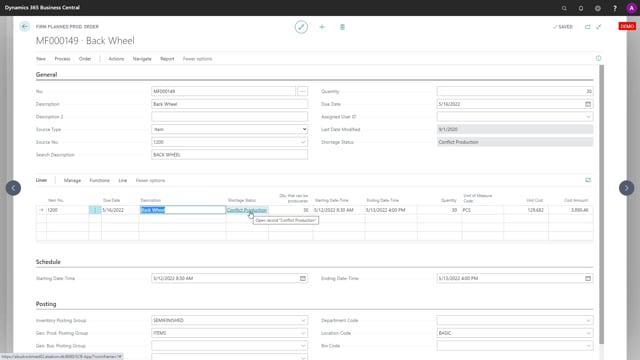


When you work with production orders in Business Central, the shortage status feature helps you see at a glance whether you have the components you need to complete a production order. Here is how the calculation works and how you can use it to find the components that are missing.
The shortage status rolls up from the individual component lines to the production order line and the production order header. If you see a shortage at the top level, you can drill down to find exactly which component is causing the problem.
The production order line itself is a supply, not a demand, so the shortage status there reflects the worst status found among the components rather than a shortage on the line itself.
How the shortage status is calculated on a production order
When you calculate the shortage status on a production order, Business Central displays the status on both the production order line and the production order header. What it actually does behind the scenes is run through all the component lines and calculate the shortage status on each production order component.
The production order line is a supply and not a demand, so it does not make sense to talk about a shortage status on the line itself. Instead, the system runs through the component lines, checks whether any of them has a shortage, and then rolls up the worst shortage status it finds.
Drilling down to find the missing components
Because the status shown on the production order line is an accumulated value, you can click the field and drill down to the production order components. This lets you see the different shortage statuses on each component line.
In this way, you can move down through the hierarchy and see how the shortage status accumulates. Rather than just knowing that something is missing on a production order, you can pinpoint the specific component that is causing the shortage and act on it.
Q&A
What does the shortage status on a production order line show?
It shows the worst shortage status found among the components on the order. The production order line is a supply, not a demand, so the status is rolled up from the underlying component lines rather than calculated on the line itself.
How do I find out which component is causing a shortage?
Click the shortage status field on the production order line to drill down to the production order components. There you can see the individual shortage status on each component line and identify exactly which component is missing.
Where is the shortage status displayed?
The shortage status is displayed on both the production order line and the production order header, with the value accumulated from the component lines below.