
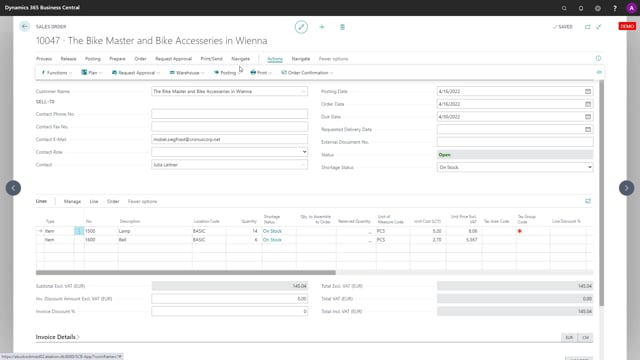


When you run an order promising or availability check in Business Central, you can control which incoming supply the system counts toward covering a sales order. Two settings determine this: Include Expected Supplies and Include Only Promised Supplies.
If you select neither, the calculation looks only at current inventory. Any purchase orders on their way are ignored, so a line can show as a conflict even though stock is arriving.
If you select Include Expected Supplies, the calculation counts incoming purchase orders. A line that was short on inventory can then show as covered.
If you select Include Only Promised Supplies, the calculation counts only purchase order lines that have a value in the Promised Receipt Date field. Purchase orders without a promised date are excluded, so the line stays in conflict until you confirm a promised date with the vendor.
How the shortage check uses inventory and due dates
The starting point is a sales order line and its due date. When you run the calculation with no expected supplies included, the system compares the demand against what you have physically on stock as of that date.
In the example used here, the top line on the sales order shows a shortage status of Conflict Stock. There is not enough inventory to cover the demand on the due date, because the check is based on the due dates of the lines.
Including expected supplies from purchase orders
When you turn on Include Expected Supplies and run the calculation again on the same sales order, the result changes. The system now looks at the purchase orders coming in.
In the example there is one purchase order arriving for that line. Once it is included, the line moves from conflict to On Stock. The expected receipt is enough to cover the demand on the due date.
Restricting the calculation to promised supplies only
The third option is to run the calculation with Include Only Promised Supplies selected. This is stricter, because it only counts purchase order lines that have a date in the Promised Receipt Date field.
In the example, the relevant purchase order line falls before the due date but has no promised delivery date. With only promised supplies included, that line is ignored, and the sales order line shows Conflict Stock again.
To fix this, go to the purchase order. There are four purchase orders in this scenario, but only one falls before the due date, and it is on the same item number. Enter a value in the Promised Receipt Date field on that line, for example April 12.
Now go back to the sales order and run the calculation again, still with only promised supplies included. Because the purchase order line now has a promised receipt date, it is included in the calculation, and the sales order line shows as On Stock.
Choosing the right setting for your supply planning
You have three ways to handle incoming supply when you check availability:
- Include no expected supplies if you want the check based purely on current inventory.
- Include all expected supplies if you want every incoming purchase order counted, regardless of whether a delivery has been confirmed.
- Include only promised supplies if you want to count only the purchase order lines where the vendor has confirmed a date in the Promised Receipt Date field.
The promised supplies option gives you the most realistic picture when you need to rely on confirmed deliveries rather than expected ones.
Q&A
What does the shortage status Conflict Stock mean?
It means there is not enough inventory to cover the sales order line on its due date, based on the supply the calculation is set to include.
What is the difference between Include Expected Supplies and Include Only Promised Supplies?
Include Expected Supplies counts all incoming purchase orders. Include Only Promised Supplies counts only purchase order lines that have a value in the Promised Receipt Date field, so unconfirmed deliveries are excluded.
Why does a purchase order not count toward covering a sales order line?
If you run the check with only promised supplies included, a purchase order line without a Promised Receipt Date is ignored. Enter a promised receipt date on the line to have it counted.
How do I make a purchase order count when using promised supplies only?
Open the relevant purchase order line and fill in the Promised Receipt Date field. When you run the availability calculation again, the line is included and the sales order can show as On Stock.