
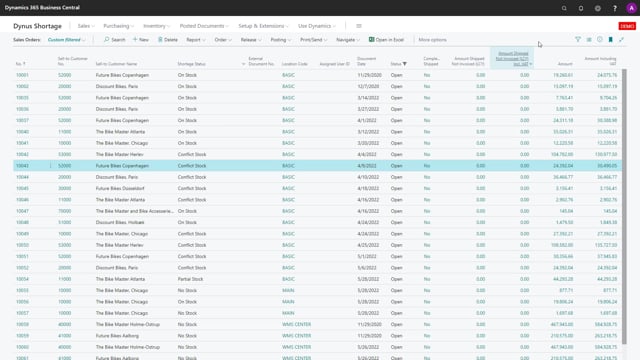


The shortage status on sales orders helps you see at a glance whether you can deliver what you have promised. The status is calculated on each sales order line, and the worst status is transferred up to the sales order header. This article explains how the calculation works, the two ways you can run it, and how to read the status field.
How the shortage status is calculated on sales order lines
The shortage status is calculated for each individual line on a sales order. The functionality runs through all the lines and works out the status for each of them. Once that is done, it transfers the worst status from the lines up to the sales order header.
This means the status field on the sales order header always shows the same status as one of the lines. Specifically, it shows the worst one. The further down you get on the list of statuses, the worse the status is, so the header reflects the line that is in the most critical situation.
Two ways to run the shortage status calculation
You can calculate the shortage status in two ways.
The first option is to run the Calculate Shortage Order Status report. You can set different parameters on it, and it recalculates the status for all sales orders at once. Under the hood, the report simply runs through your sales orders one at a time and applies the same calculation to each of them.
The second option is to run the Calculate Shortage Status functionality directly from a single sales order. This is exactly what the report does for each order behind the scenes. So whether you run it for one order from the order itself, or for all orders through the report, the result for that order is the same.
Q&A
How is the shortage status determined on the sales order header?
The status is calculated on each sales order line, and the worst status among the lines is transferred to the sales order header. The header always shows the same status as one of the lines, namely the worst one.
What are the two ways to calculate the shortage status?
You can run the Calculate Shortage Order Status report, which recalculates the status for all sales orders at once, or you can run the Calculate Shortage Status functionality directly from a single sales order.
What does the Calculate Shortage Order Status report actually do?
It runs through your sales orders one at a time and applies the same calculation that you would get by running the function from an individual sales order. You can adjust its behaviour using different parameters.
How do you read the status values?
The further down the list of statuses you get, the worse the status is. The sales order header reflects the line with the worst status.