
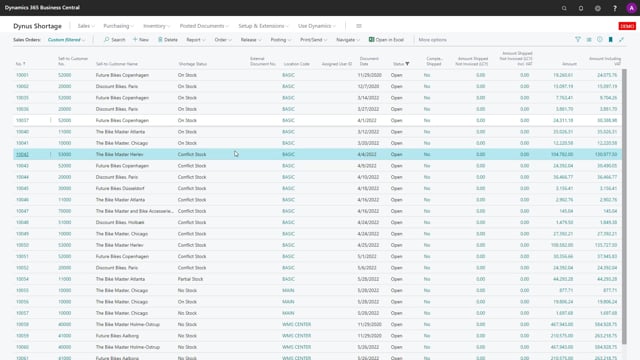


The shortage report in Microsoft Dynamics 365 Business Central can calculate availability in two different ways, depending on whether you enable the Use Due Date field. When you enable it, each order line is calculated only up to its own due date. When you leave it disabled, every line is calculated across the full period defined by your filter.
This setting directly affects whether an order line shows as on stock or in shortage. Two orders containing the exact same items can return different results, because the calculation window changes based on each line’s due date.
What the Use Due Date field does on the shortage report
The Use Due Date field on the shortage report controls how far ahead the calculation looks when it checks availability for an item.
If you do not select the field, the report ignores the individual due dates. It calculates each line across the full interval for the item, all the way to the end date in your filter. In this example, that end date is December 31.
If you do select the field, the report takes the due date of each line into account. It only calculates demand and supply up to that line’s due date, which gives you a more precise picture for each order.
How two orders with the same items can give different results
Consider two orders, number 41 and number 42. Both contain the exact same items.
With the Use Due Date field disabled, both orders are calculated up to December 31. They both show as in shortage, because the calculation looks across the full period for the item.
When you enable the Use Due Date field, the results differ:
- Order 41: The top line on item 1000 has a due date of March 27. The report calculates everything up to March 27. If there is no conflict before that date, the line shows as on stock. Both lines on this order come out on stock.
- Order 42: Same items, but the first line is due on April 4. The report calculates everything up to April 4, which includes the demand in March. That additional demand creates a conflict, so the line shows as in shortage.
The difference comes entirely from the due dates. Because order 42 reaches further into the calendar, it picks up more demand and tips into shortage, while order 41 stays clear.
Choosing the right setting for your calculation
Use the Use Due Date field when you want availability checked against each line’s actual due date. This gives you a realistic view of whether an order can be fulfilled on time.
Leave the field disabled when you want to evaluate availability across the full filter period instead. In that case, every line is measured against the same end date, regardless of when it is actually due.
Q&A
What does the Use Due Date field do on the shortage report in Business Central?
It controls how far ahead the calculation looks. When enabled, each line is calculated only up to its own due date. When disabled, every line is calculated across the full period set by your filter.
Why do two orders with identical items show different availability results?
Because their due dates differ. With Use Due Date enabled, an order with a later due date includes more demand in its calculation window, which can create a conflict that an earlier order avoids.
What happens if I do not select the Use Due Date field?
The report ignores the individual due dates and calculates every line up to the end date in your filter, for example December 31. This can cause lines to show as in shortage that would otherwise be on stock when measured against their own due dates.