
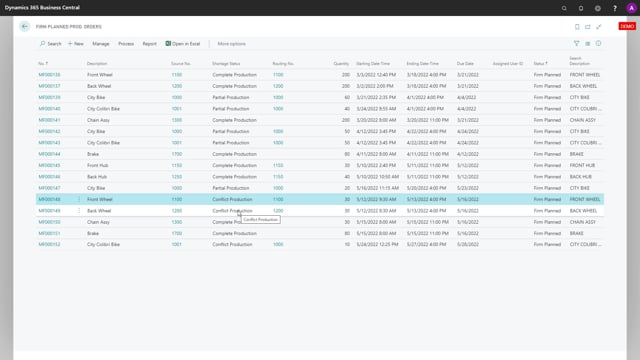


The shortage on production order functionality in Microsoft Dynamics 365 Business Central helps you check whether you can cover the component demand before you release a production order. When several production orders compete for the same components, you cannot trust a status that says complete until you have actually picked and posted. The realistic approach is to prioritise the orders, handle them one at a time, and rerun the shortage check after each pick to see what is still available.
You can release and pick orders with a complete production status straight away. For orders flagged with a conflict, you need to release, complete the pick, and post the pick for one order before you know whether the components are still there for the next one.
Using shortage on production order to check component demand before release
The shortage on production order functionality lets you verify that you can fulfil the component demand before you release a production order. This gives you a clear picture of which orders are ready to go and which ones depend on components that are also needed elsewhere.
Orders that show a complete production status are straightforward. You can release them, or change the status to released, and then start picking the components. There is nothing competing for those parts, so they are ready to move forward.
Handling production orders that conflict over the same components
The complication appears with orders that show a conflict in the production status. Each of these can be handled on its own, but they share component demand. The moment you start picking components for one of them, the others will conflict because the parts you just allocated are no longer available.
You cannot rely on the status alone here. An order may look like it can be covered, but that picture only holds true until another order consumes the same components.
A strategy for releasing conflicting production orders one at a time
When you have conflicting orders, the practical method is to take all of them and work through them in sequence. In a typical case you might only have a handful on the list, for example three orders, but the principle is the same regardless of the number.
Follow these steps for each order:
- Prioritise the conflicting orders so you know which one to handle first.
- Release the first order.
- Complete the pick.
- Post the pick.
Only after you post the pick can you rerun the shortage status on the remaining production orders and see whether it is possible to pick the next one. The posting is what updates the real component availability, so it is the point where you learn what you actually have left to work with.
Repeat the process for the next order in your priority list, and continue until you have worked through all the conflicting orders. This gives you a controlled strategy for releasing production orders when component supply is tight.
Q&A
What does the shortage on production order functionality do?
It lets you check whether you can fulfil the component demand for a production order before you release it, so you know which orders are ready and which ones depend on components needed elsewhere.
How do I handle production orders with a complete production status?
You can release them or change their status to released and start picking the components straight away, since nothing else is competing for those parts.
Why do production orders conflict over components?
Several orders can depend on the same components. As soon as you pick components for one order, those parts are no longer available, so the other orders that needed them go into conflict.
How should I release production orders that conflict over the same components?
Prioritise the conflicting orders, then handle them one at a time. Release the first order, complete the pick, and post the pick. Then rerun the shortage status to see whether you can pick the next order, and repeat for each remaining order.
Why do I need to post the pick before checking the next order?
Posting the pick updates the actual component availability. Only after posting can you rerun the shortage status and see realistically whether the components are still there for the next production order.