
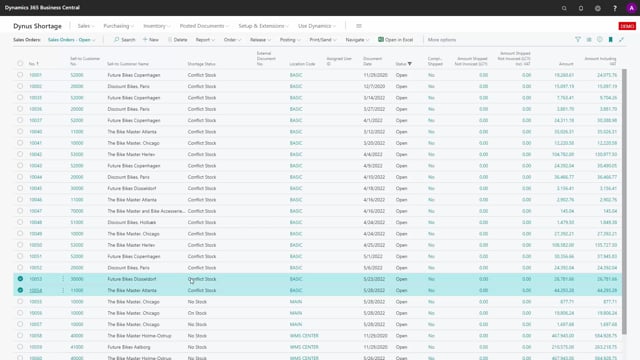


When you start shipping, knowing exactly which orders you can fulfil makes a real difference. Shortage status helps you see when two orders are competing for the same stock, so you can decide which one to ship without accidentally turning the other into a partial delivery.
You can calculate shortage status either with a report across orders or directly on a single sales order. The single-order calculation is the one you reach for most often once shipping is underway.
How to calculate shortage status in Business Central
You have two options for calculating shortage status. You can run a report that calculates the status across your orders, or you can calculate it directly on a single sales order. The single-order method is particularly useful when you are about to ship and need to know straight away whether the items are available.
To get a fresh picture, run the report so the status is recalculated. After that, you can open a sales order and see the current stock situation for each item.
What conflict stock means on a sales order
When you open a sales order, you may see that items are marked as conflict stock. This happens when more units are committed across sales orders than you have available in inventory.
Take item number 1050 as an example. You have 10 units in inventory, but 12 units are committed across sales orders. That is the conflict: there is not enough stock to satisfy every order in full.
In practice this means you can ship either of the two orders right now, but not both. If you ship one of them, the other one cannot be fully shipped and becomes a partial delivery. That is exactly why the items are flagged as conflict stock.
Using shortage status when shipping
Shortage status gives you a clear view before you commit to a shipment. When two orders share the same limited stock, both show as conflict stock until you ship one of them. The moment you ship one order, the available quantity drops and the other order can no longer be filled completely.
By calculating shortage status on the single order, you can make that decision deliberately rather than discovering the shortfall after you have already shipped.
Q&A
What does conflict stock mean in Business Central?
Conflict stock means that more units of an item are committed across sales orders than you have available in inventory. For example, if you have 10 units in stock but 12 units committed across orders, the orders are in conflict because you cannot ship all of them in full.
How do you calculate shortage status?
You can calculate shortage status in two ways: by running a report that calculates the status across your orders, or by calculating it directly on a single sales order. The single-order method is the most practical when you are about to ship.
Why should you calculate shortage status on a single order before shipping?
Because it shows you whether shipping one order will leave another order short. When two orders compete for the same limited stock, both appear as conflict stock. Shipping one reduces the available quantity, so the other can only be partially delivered. Checking first lets you decide which order to ship deliberately.