
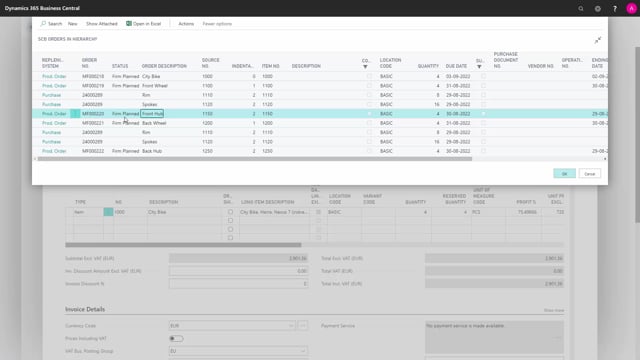


Sådan håndterer Business Central produktionsordrer i et flerniveau-hierarki
When you work with manufacturing in Business Central and break down a finished item into its components, the system builds a hierarchy of orders for you. Here is how that hierarchy works in practice, using a bicycle wheel as the example.
The order hierarchy is created automatically from the production order
Once you create the production order, Business Central generates the underlying orders and hierarchy automatically. From the sales order line you can then open the hierarchy and navigate directly into the different orders that came out of it.
These orders are the result of unfolding the hierarchy. Each level of the product structure gets the orders it needs, whether that is a production order for an assembled item or a purchase order for a component you buy from a vendor.
Shared components are accumulated on a single purchase order
One detail worth noticing is how the system handles components that appear in more than one place. In this example, the rim and spokes are part of both a front wheel and a back wheel. Instead of creating two separate purchase orders for the same items, Business Central adds them to the same purchase order and accumulates the quantities from both wheels.
That means you end up with only one purchase order for these shared components, even though there are several different production orders behind the finished product. It also means you avoid contacting the vendor with two separate orders for what is effectively the same purchase.
Navigating and releasing the orders
From the menu you can open the documents in the scenario directly, whether it is a purchase order or a production order. A newly generated production order starts as a firm planned order. When you change the status to released, it moves onto the list of released orders.
This makes it straightforward to navigate into each document and to keep an overview of the full hierarchy from the sales order all the way down to the individual components.
Q&A
How is the order hierarchy created in Business Central?
The hierarchy is created automatically once you create the production order. From the sales order line you can view the hierarchy and navigate into the different orders that were generated.
What happens when a component is used in more than one production order?
Business Central adds the shared component to a single purchase order and accumulates the quantities. In the bicycle example, the rim and spokes are used in both the front and back wheel, so they are combined onto one purchase order instead of two.
What status does a newly generated production order have?
It starts as a firm planned order. When you change the status to released, it appears on the list of released orders, making it easy to navigate into the document.
Why does the system avoid creating separate purchase orders for the same component?
It prevents you from contacting the vendor with two different purchase orders for the same item. By accumulating the quantities on one purchase order, you keep your purchasing simpler and consolidated.