
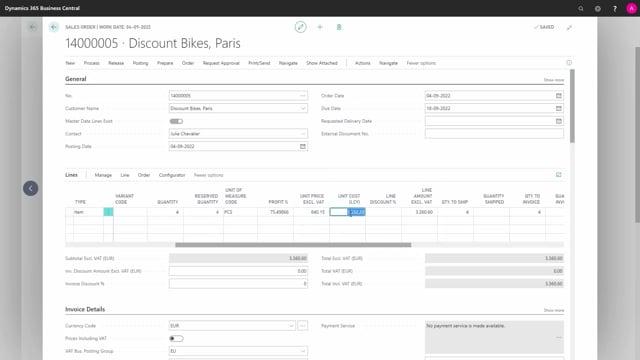


In Microsoft Dynamics 365 Business Central, you can roll up the expected cost through a manufacturing hierarchy. Once you have built the hierarchy, the system calculates the cost from the actual purchase order lines and component lines below it.
The unit cost reflects the quantity you produce. Setup time is spread across the quantity, so the cost per unit changes depending on how many units you make.
You can update the item’s unit price directly from the cost calculated in the hierarchy.
The calculation includes lower level components, even when those components are standard inventory items that are not part of the hierarchy. They are pulled in through the production order.
How the Expected Cost Rolls Up Through the Hierarchy
Once you have created your hierarchy, you can roll the expected cost up through it. In the example, the item ends up with a cost of 1,309. That figure depends on the quantity, because the quantity affects how setup time and similar fixed costs are distributed across the units.
The unit cost comes from the actual hierarchy. That means it is built from the real purchase order lines and the real component lines in the structure, not from a separate cost field.
Updating the Cost When You Change the Production Order
If you open the order hierarchy and go into a document, you can change the price on production orders or purchase orders. You can also adjust the bill of material or the routing. For example, you can add more time, add more operations, or add subcontracting steps if you need to produce the item differently.
When you go back to the view and roll up the expected cost again, it updates with the changes you made. In the example, the unit cost becomes higher after the changes.
Lower Level Components Are Included Automatically
The calculation also pulls in the components below the item. When you view the hierarchy with its components, all the existing non-hierarchy items are included through the production order.
This means that calculating the price on a production order includes the lower level items, even if a given item is just a standard inventory stored item. That is how the cost is calculated, and you can update the unit cost with the profit included.
Q&A
Where does the unit cost in the hierarchy come from?
The unit cost comes from the actual hierarchy, meaning the real purchase order lines and component lines in the structure. It is not taken from a separate static cost field.
Why does the unit cost change with the quantity?
The quantity is taken into account because fixed costs such as setup time are spread across the units you produce. A larger quantity distributes the setup time over more units, which changes the cost per unit.
Are standard inventory components included in the cost calculation?
Yes. All existing non-hierarchy items are included through the production order. Calculating the price on the production order pulls in the lower level items even when an item is just a standard inventory stored item.
What happens to the expected cost if I change the bill of material or routing?
When you change the price on a production or purchase order, adjust the bill of material or routing, add more time or operations, or add subcontracting, the expected cost updates accordingly the next time you roll it up.