
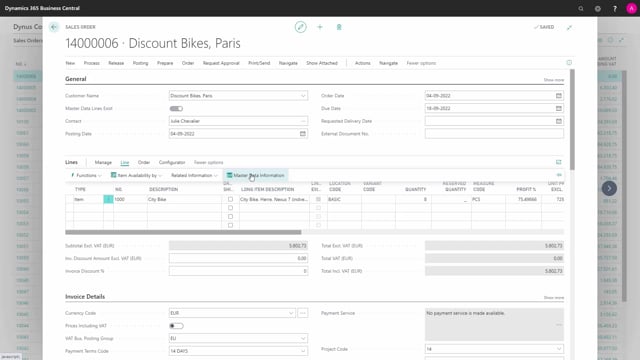


When a customer orders a product that deviates from your standard catalogue, the sales order rarely tells the whole story. Someone with production knowledge needs to verify that the order can actually be made before you commit to the customer. This article walks through how that handover works in Business Central, from the firm planned production order to the feedback the planner gives back to sales.
The salesperson records the customer’s requirements as master data on the item, then creates a firm planned production order linked to the sales order. Before the production hierarchy is built, the salesperson passes the order to a planner or an item development responsible. That person reviews the bill of material and the routing, adjusts setup and run times where the item is no longer standard, and confirms whether the order is doable.
The substitution functionality can auto-correct the bill of material in some cases. When it does not, the planner corrects the component list manually.
From sales order to firm planned production order
The process starts with the salesperson capturing the master data information from the customer. This means the specific requirements the customer wants reflected in production. Once that is in place, the salesperson creates a production order tied to the sales order. This is a firm planned production order, but the production hierarchy has not been created yet at this stage.
Handing the order over to the planner
Before the hierarchy is built, the salesperson typically tells the planner or the item development responsible to step into the order. That person opens the order and looks at the item, the master data information, and the customer’s requirement. The point is to bring production knowledge to bear before anything is promised to the customer.
Correcting the bill of material and component list
The first task is to get the bill of material right. If the substitution functionality has not already auto-corrected it, the planner does this manually. That means going through the component list and figuring out whether all the components are the correct ones for what the customer actually ordered.
Adjusting the routing, setup time, and run time
A custom order rarely behaves like a standard item on the shop floor. The planner may also need to change the routing. Setup time can be much longer because the item is no longer a standard item, and some of the run time can be longer too. Adjusting these values gives a realistic picture of what the order will take.
Confirming feasibility and giving feedback to sales
With the bill of material, component list, and routing prepared, the planner can figure out whether the order is actually possible to produce. The final step is to give feedback to the salesperson confirming that it is doable. That closes the loop and lets sales commit to the customer with confidence.
Q&A
What is a firm planned production order in this process?
It is a production order the salesperson creates and links to the sales order after capturing the customer’s master data requirements. It is created before the production hierarchy is built and serves as the basis the planner reviews.
Who corrects the bill of material on a custom order?
The planner or the item development responsible does it. The substitution functionality can auto-correct the bill of material in some cases. When it does not, the planner reviews the component list and corrects it manually.
Why might setup time and run time need to be longer on a custom order?
Because the item is no longer a standard item. The planner may need to change the routing so that setup time and run time reflect the extra work the custom order requires.
What happens after the planner has prepared the production order?
The planner figures out whether the order is actually possible to produce, then gives feedback to the salesperson confirming that it is doable.