
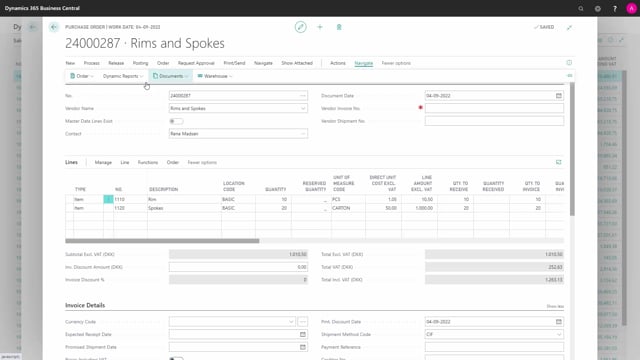


The configurator in Microsoft Dynamics 365 Business Central lets you add master data that runs through every level of your product hierarchy. When you specify product details on a sales order, you can pass that information all the way through to the purchase order and print it on documents to your vendor. This keeps custom specifications consistent from the customer’s request to the supplier.
If you change a specification after the hierarchy is already built, the change does not flow automatically to existing purchase orders. You have to update them manually. In practice, this means your sales people need to tell you when a specification changes, so you can update the master data and refresh the affected purchase orders.
You can print the resulting specifications directly to the vendor if you have a printing solution in place, such as the Document Customizer app.
Adding master data that flows through the hierarchy
With the configurator you add master data once, and it runs through all the hierarchies. When you enter specific information on a product, that information can be transferred all the way through the hierarchy when you build it.
Take a bike as an example. The standard product might be a 7-gear bike, but a customer wants a 20-gear bike instead. You enter that specification, and it can be carried through the hierarchy from the sales order down to the purchase order.
Updating purchase orders after a specification change
The transfer happens when you build the hierarchy. If you change a specification after the hierarchy is already built, the existing purchase orders do not update on their own.
Say you change the bike from a 7-gear to a 20-gear model after the purchase order is created. If you view the master data as it was, it still shows the 7-gear bike. Once the sales people have changed the sales order, you need to update the purchase order to match. After you update the master data information and look at it again, it reflects the new specification.
This depends on communication between sales and purchasing. The sales people need to tell you when a specification changes, so you can update your master data and the purchase orders that depend on it.
Printing specifications to the vendor
Once the information is bound from the sales order, through the hierarchy, to the purchase order, you can print it on the document. This works if you have a printing solution set up, for example the Document Customizer app, which lets you print the specification directly to the vendor.
Q&A
What does the configurator let you do with master data in Business Central?
It lets you add master data that runs through all the hierarchies. When you enter specific product information, you can transfer it all the way through the hierarchy, from the sales order to the purchase order.
Do purchase orders update automatically when you change a specification?
No. The information transfers when you build the hierarchy. If you change a specification after the hierarchy is already built, you need to update the existing purchase orders manually.
How do you keep specifications in sync between sales and purchasing?
The sales people need to tell you when a specification changes on the sales order. You then update the master data information and refresh the affected purchase orders so they match.
Can you print the configured specifications to your vendor?
Yes. Once the information is bound from the sales order through the hierarchy to the purchase order, you can print it on the document, provided you have a printing solution such as the Document Customizer app.