
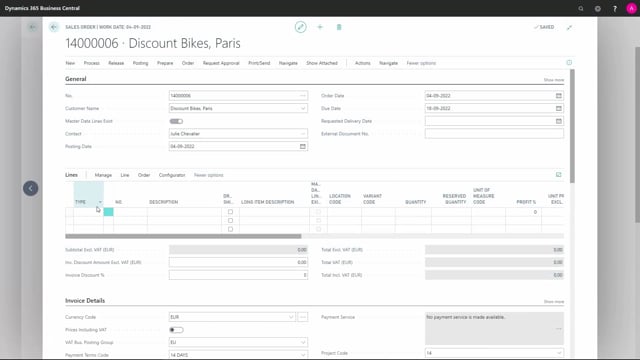


The sales configurator in Microsoft Dynamics 365 Business Central helps you find the right product configuration when a customer has specific requirements. You search across all possible configurations of a base item, not just the base items themselves.
You define search criteria as “need to have” and “nice to have.” The search returns every item that fulfills all need-to-have criteria. The nice-to-have criteria then rank the results, so you can see how close each match is.
You can build search templates that predefine the relevant criteria for a product type, such as a bicycle. This makes it faster to search for the parameters that matter, like bike type or number of gears.
The configuration search uses the same functionality as the master data information app, so what you learn in one applies to the other.
Why you need configuration search in the sales configurator
You might only have 10 base items for bicycles in your system. But in real life, those base items can expand into hundreds, thousands, or even millions of possible configurations. A customer often wants one very specific combination.
Searching manually through all those configurations is not practical. The configuration search window lets you describe what the customer wants and find the item with the best fit.
How to set up the search
You have two starting points. You can base the search on an existing item number and unfold the master data from that item. Or you can build templates that define the search criteria for a particular type of item.
Templates make the process repeatable. For a bicycle, you can define a template that exposes the relevant parameters up front, so you don’t have to set them each time.
Entering customer requirements
Once you have a template or item to work from, you enter what the customer is looking for. For a bicycle, that could be the bike type, for example a male bike, and the number of gears, for example an eight-gear bike. You enter whatever parameters apply to your products.
You can enter values as configuration values, or you can enter them directly as filter criteria instead. This gives you flexibility in how you describe the requirement.
Need to have versus nice to have
For each search, you decide which criteria are mandatory and which are preferences. The need-to-have criteria are absolute. Every item in the result list fulfills all of them.
The nice-to-have criteria are where the results differ from each other. The search counts how many of these each item misses.
Reading the search results
The result list shows you the matching items and how well each one fits. For example, if you left the tire type out of the criteria and ran the search, you might see four bikes with one mismatch. You can pick any of those four, and you only need to change one thing to meet the requirement.
You might also see a bike with two mismatches or deviations. The list ranks items by how many changes you would need to make, so you can quickly choose the closest fit for the customer.
Q&A
What is the difference between need-to-have and nice-to-have criteria in the sales configurator?
Need-to-have criteria are mandatory. Every item in the search result fulfills all of them. Nice-to-have criteria are preferences that rank the results. The search shows how many nice-to-have criteria each item misses, so you can see which items are the closest fit.
Why does the sales configurator search across configurations instead of base items?
A small number of base items can expand into hundreds, thousands, or millions of possible configurations. Customers usually want one specific combination. Searching across configurations lets you find that exact match instead of looking only at the base items.
Can I reuse search criteria for the same product type?
Yes. You can build templates that predefine the relevant search criteria for a product type. This means you don’t have to set up the parameters from scratch each time you search.
Can I enter requirements as filters instead of configuration values?
Yes. You can enter requirements either as configuration values or directly as filter criteria, giving you flexibility in how you describe what the customer wants.