
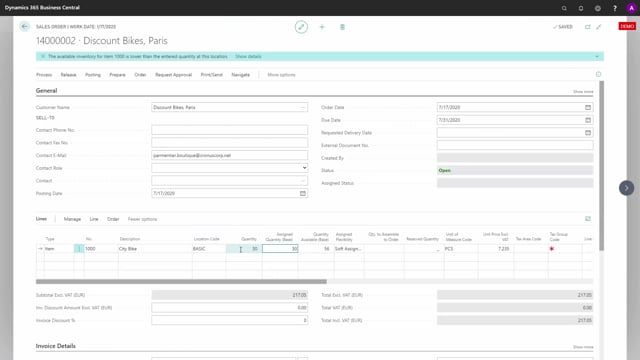


The assigned quantity feature in Business Central gives salespeople an immediate picture of item availability when they create a sales order line. You get warnings if an item is not available in the quantity you need by the shipment date you have entered. This helps you avoid promising stock you cannot actually deliver.
When you enter a quantity that exceeds what is available on a given shipment date, Business Central only assigns the quantity it can actually cover. If you move the shipment date forward, the system can look ahead within a configured period and tell you the first possible date on which the full quantity can ship.
You can set the look-ahead period yourself. In this example it is set to two months. If a future shipment date falls within that window and inventory becomes available, Business Central offers to move the shipment date so you can ship the full order.
How assigned quantity works on a sales order line
When you create a sales order line and enter a shipment date, the assigned quantity feature checks your inventory against that date. In this scenario the shipment date is 15 July and the available quantity is 56. Entering a quantity of 30 on the line lets you assign all 30, because the inventory covers it.
You can verify this in the graphical inventory profile. With the assigned quantity shown, the line appears on 15 July with the quantity you entered, and your inventory stays above zero.
What happens when stock is not available on the shipment date
If you move the shipment date earlier, to 15 February for example, shipping the full quantity on that date would push your inventory below zero and prevent other orders from being shipped. When you enter 30 in this situation, Business Central only assigns the quantity it can cover, which in this case is one.
In the graphical profile you can checkmark the option to see only the sales order line you actually assigned. You can then see the inventory drop to zero, with your February order carrying only the quantity of one that could be assigned.
Using the look-ahead period to move the shipment date
The look-ahead period determines how far forward Business Central searches for a date on which the full quantity can ship. In this example the period is set to two months.
If you move the shipment date to 15 March, shipping the full quantity on that date would still take inventory to zero. But because the system looks two months ahead, it is possible to move the item to a date where the whole order can be shipped.
When you enter the quantity, Business Central presents a message. If you say no and keep the shipment date, it assigns only what is available, which is one. If you say yes, it assigns the full quantity and moves the shipment date to the first possible date within the two-month window. In this scenario that date is 25 April.
This gives you, as a salesperson, an easy way to create a sales order line and see item availability without leaving the order.
Q&A
What does the assigned quantity feature do on a sales order line?
It checks item availability against the quantity and shipment date you enter, and warns you if the item is not available in the quantity you need by that date. It then assigns only the quantity that can actually be covered.
What happens if I enter a quantity that exceeds available stock for the shipment date?
Business Central assigns only the quantity it can cover for that date. If you enter 30 but only one unit is available, it assigns one, so you do not promise stock that would push inventory below zero or block other orders.
What is the look-ahead period and how does it affect shipment dates?
The look-ahead period sets how far forward the system searches for a date on which the full quantity can ship. With a two-month period, Business Central can offer to move the shipment date to the first possible date within those two months so you can ship the entire order.
Can I keep my original shipment date instead of moving it?
Yes. When Business Central offers to move the shipment date, you can say no to keep the original date. It then assigns only the quantity available on that date. If you say yes, it assigns the full quantity and moves the shipment date to the first possible date within the look-ahead period.