
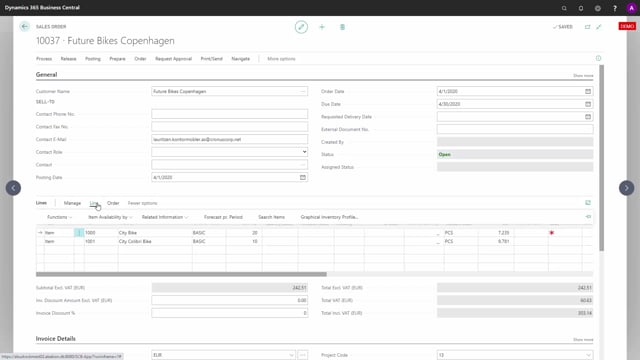


The Assign Quantity app for Business Central lets you control how much of a sales order quantity is actually backed by available inventory. When you install the app, none of your existing orders have an assigned quantity yet. You run a batch job called Assign Sales Order Quantity once to populate the assignment on all existing orders. After that, Business Central assigns quantity automatically every time you enter a new sales order line.
The app works with three fields on the sales line: Assigned Quantity (Base), Assigned Quantity Available (Base), and Assigned Flexibility. When you enter a new line, the app checks how much inventory is actually available and assigns only that amount. If you ask for 30 pieces but only five are available, it assigns five.
You can run the batch job for all items and all locations at once, or limit it to specific item groups or a single location. Running it across the whole system can be a large batch job depending on your data volume.
Getting started after activating the Assign Quantity app
Right after you install the app, no assigned quantity is filled in on your existing sales orders. To see this, open a sales order and look at the Assigned Quantity (Base), Assigned Quantity Available (Base), and Assigned Flexibility fields. They start out empty.
To illustrate what happens, you can use the Graphical Inventory Profile app. This is a free app on AppSource. It is not part of Assign Quantity, but it is useful for showing how inventory is affected. Take a sales order line for City Bike, 20 pieces, on order number 137. If you open the graphical inventory profile for that location and item number 1000, you see the sales order with a quantity of 20 on 29 January. The profile shows a start inventory of 76 and an end inventory of 5.
How assigned quantity affects the inventory profile
If you run the graphical inventory profile again and check the field Use Assigned Quantity From Sales Line, the calculation uses the assigned quantity instead of the full order quantity. Since nothing is assigned yet, all your sales orders have an impact of zero, and only your supply orders fill up the inventory. In this example, the end inventory then shows 206.
If you assign that specific line manually from the Assign Quantity menu, the app checks whether the item is available. With an end inventory of 206, the 20 pieces are clearly available, so it assigns all 20 to the sales order line. Look at the graphical profile again with assigned quantity included, and the end inventory drops by 20 to 186, because those 20 pieces are now assigned to the order.
Running the Assign Sales Order Quantity batch job
Once the app is active, it does this assignment automatically. But for your existing orders, you need to run a batch job once to assign quantity on everything already in the system.
Select Assign Quantity from the menu and find the report called Assign Sales Order Quantity. To begin with, you can simply run it for everything up to whatever date you prefer. For example, run it through the end of December this year, for all items and all locations. You can also limit it to groups of items or a single location.
The batch job runs through all sales order lines, all outbound transfer order lines, all outbound assembly order lines, and assigns quantity to them. After it finishes, the graphical profile with assigned quantity from sales orders looks like the original profile, because everything is now assigned.
How automatic assignment works on new sales lines
Once everything is assigned, you are ready to go. When you enter a new sales order line, Business Central looks at the exact available quantity and assigns accordingly.
For example, create another sales order line on the same item and location, and enter a shipment date such as 1 April. You know the end inventory is five. If you enter 30 on the line, the app automatically assigns only five, because that is all that is left for this item.
If you look at the graphical profile with sales order quantity included, the end inventory shows zero, because only five were assigned. If you look at the profile without assigned quantity, including all quantities, you see an inventory of minus 25. That difference is the non-assigned quantity.
Q&A
What is the Assign Quantity app in Business Central?
It is an app that controls how much of a sales order quantity is actually backed by available inventory. It works with the fields Assigned Quantity (Base), Assigned Quantity Available (Base), and Assigned Flexibility on the sales line.
What do you need to do right after activating the app?
Run the batch job called Assign Sales Order Quantity once. This populates the assignment on all your existing sales orders, transfer order lines, and assembly order lines, since none of them have an assigned quantity until then.
Can you limit the batch job to specific items or locations?
Yes. You can run it for all items and all locations, or limit it to groups of items or a single location. Running it across the whole system can be a large batch job depending on your data.
What happens when you enter a new sales order line after the app is active?
Business Central looks at the available quantity and assigns automatically. If you enter 30 pieces but only five are available, it assigns only five.
What is the Graphical Inventory Profile app and is it part of Assign Quantity?
It is a free app on AppSource that visualises your inventory profile. It is not part of Assign Quantity, but you can use it to see how assigned and non-assigned quantities affect your inventory. Enable Use Assigned Quantity From Sales Line to view the assigned amounts.