
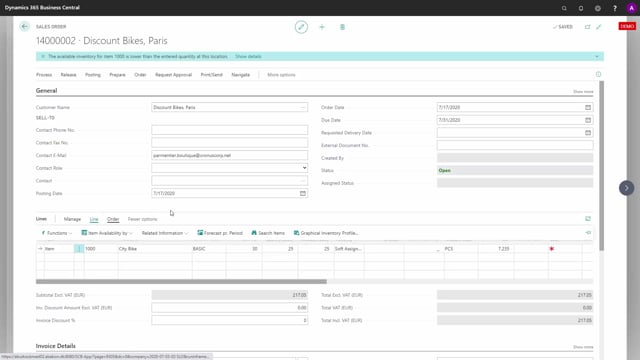


When you enter a quantity on a sales order in Business Central, the system doesn’t always assign the full amount. You enter 30, and it assigns 25. The question is why, and how you can explain it to yourself or to a colleague.
Use the free Graphical Inventory Profile app from AppSource to see exactly what is assigned and why. It uses the same calculation engine as the assigned quantity, so it produces the same math and works as a reliable explanation tool.
To make the Graphical Inventory Profile match the assigned quantity, set the same checkmarks and filters in both. You find the assigned quantity settings under Item Availability General Setup List, on the line for assigned quantity. If the filters differ, the two results will not match.
Why a sales order assigns less than the entered quantity
A common scenario looks like this: as a salesperson you enter quantity 30 on a sales order, and Business Central assigns only 25. You want to know why it assigned 25 and not 30, what your inventory actually is, and how to make sense of the situation.
The more complex your inventory profile is, the harder this becomes to explain. You could open the item card and work through all the entries manually, but that gets difficult fast.
Use the Graphical Inventory Profile app to explain assignments
The better approach is the app called Graphical Inventory Profile. It’s a free app on AppSource that we built at Abakion. The important part is that it uses the same base engine that handles the assignment itself. It’s the same math, which makes it a good tool for explaining what’s going on.
When you open the graphical profile, you have a number of checkmarks you can set. For example, you can view the profile including the quantity assigned on sales orders. When you run it that way, you see all your movements, all your sales orders, your beginning inventory, and so on.
If you’ve made your assignment correctly, the profile should never go below zero. That holds true whether you’ve run the report to assign, or you’ve simply entered all the demands after the supplies.
You can also run the graphical profile based on all the inventory rather than on what was assigned. Then you see your complete inventory profile. In that view you might spot sales orders that won’t get enough, and the chart drops below zero. That tells you there’s a problem you need to act on.
When a customer asks why the system does what it does, this is the tool we run. It’s a clear way to explain what’s happening line by line.
Match the calculation engine settings between the two tools
There’s one important thing to be aware of. The engine that calculates the assigned quantity must use the same settings as your graphical inventory profile. Otherwise the numbers won’t line up.
When you run the graphical profile, you set a lot of checkmarks. Should it include sales order handling? Should it include outbound transfer supplies? And so on. All of those filters and checkmarks need to match the settings used in the assigned quantity calculation. If you want to understand the assignment, the two have to be configured identically.
Where to find and change the assigned quantity settings
To know what the assigned quantity calculation actually does, go to Item Availability General Setup List. From there, navigate into the assigned quantity type on the line with assigned quantity.
On that card you find the checkmarks used for the assigned quantity. Scroll down and you can see every checkmark that was set for the calculation. If you run the Graphical Inventory Profile with the same checkmarks, the result should be exactly the same.
This is also the place where you change the checkmarks. For example, if you don’t want the calculation to include outbound transfer demands, purchase orders, and so on, you adjust them here.
A practical example of mismatched settings
Here’s how a mismatch shows up in practice. In one scenario, the assigned quantity calculation included purchase quotes. But when we ran the graphical profile, it wasn’t looking at purchase quotes. That difference meant the purchase quote created a different profile.
So be aware of differences like this. As long as you keep the settings aligned, the Graphical Inventory Profile is the right tool for explaining the lines.
Q&A
Why does a sales order assign less than the quantity I entered?
The system assigns based on your available inventory and the demands and supplies it’s set to consider. If you enter 30 but only 25 is available according to the calculation, it assigns 25. The more complex your inventory profile, the more factors play into the result.
Which app helps explain the assigned quantity in Business Central?
Use the Graphical Inventory Profile app, a free app on AppSource built by Abakion. It uses the same calculation engine as the assigned quantity, so it produces the same math and works as an explanation tool.
How do I make the Graphical Inventory Profile match the assigned quantity?
Set the same checkmarks and filters in both. The filters in the graphical profile, such as sales order handling and outbound transfer supplies, must match the settings used in the assigned quantity calculation. If they differ, the results won’t line up.
Where do I find the assigned quantity settings?
Go to Item Availability General Setup List, then navigate into the assigned quantity type on the line with assigned quantity. The card shows all the checkmarks used for the calculation, and it’s also where you change them.
What does it mean if the inventory profile goes below zero?
If you’ve made your assignment correctly, the profile should never go below zero. When it does, it indicates some sales orders won’t get enough inventory, and you need to act on it.