
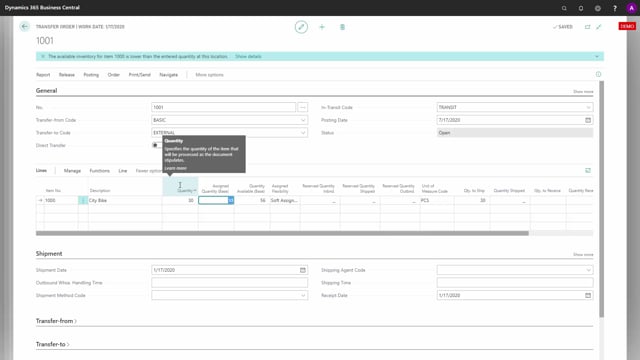


The assign quantity functionality in Business Central is not limited to sales orders. It works on all demand orders, including transfer orders. When you enter a quantity on a transfer line, Business Central can automatically assign the available quantity using a soft assignment, just as it does on a sales order. You can configure whether the assignment happens automatically or whether you assign manually.
On a transfer order, the assignment only applies to the outbound side, which is the quantity to ship. The quantity to receive is a supply, so the assign function does not apply to the inbound side.
If you change the shipment date or quantity, the transfer line does not update automatically. You reassign by running the assign quantity function again, which applies the new date and quantity.
Assign quantity works on all demand orders, not just sales orders
The assign quantity functionality applies to all demand orders. That means it covers more than sales orders. Transfer orders are a good example.
In a transfer order, you transfer items from one location to another. When you set up the location code, item number, and enter a quantity, the assignment behaves the same way it does on a sales order. If you create a transfer order from a location for item 1000 and enter a quantity of 30, Business Central can automatically assign the full quantity if it is available and show you the available quantity.
How automatic and manual assignment works on transfer orders
You can set up the system to assign automatically, or you can choose to assign manually on the transfer order. When automatic assignment is enabled and you enter a quantity, Business Central assigns the full quantity if possible using a soft assignment. This is the same behaviour you get on a sales order.
Reassigning when you change the date or quantity
Just like on a sales order, you can reassign on a transfer order. If you change the shipment date, for instance moving it back to February, the transfer line does not update automatically. Instead, you run the assign quantity function again, and it reassigns with the new date. The same applies if you change the quantity. The reassignment picks up the new values.
Assignment applies only to the outbound side of the transfer order
The assignment on a transfer order relates only to the outbound side, which is the quantity to ship. The quantity to ship is a demand, so the assign function makes sense there.
The quantity to receive is a supply. Because the assigning functionality is built for demand, it does not apply to the inbound side of the transfer order.
Q&A
Does the assign quantity functionality only work on sales orders?
No. It applies to all demand orders, including transfer orders. When you enter a quantity on a transfer line, Business Central can assign the available quantity in the same way it does on a sales order.
Can I choose between automatic and manual assignment on transfer orders?
Yes. You can set up the transfer order to assign quantities automatically or to let you assign them manually.
What happens to the assignment if I change the shipment date or quantity on a transfer order?
The transfer line does not update automatically. You run the assign quantity function again, and it reassigns with the new date and quantity.
Does the assignment apply to both the shipping and receiving sides of a transfer order?
No. It applies only to the outbound side, which is the quantity to ship, because that is a demand. The quantity to receive is a supply, so the assigning functionality does not apply to the inbound side.