


When you work with assigned quantity in Business Central, you can include supply orders in the calculation. For most customers this is the normal way to do it. The challenge comes when one of those supplies gets delayed, because that affects the sales orders you have already promised. This article walks through how the assigned quantity works, what happens when a supply is delayed, and how you can use the reassignment report to handle the situation.
You set up the assigned quantity to include the supply types relevant to you. That can be firm planned production orders, purchase orders, inbound transfer orders, or assembly orders. Whatever supply you select gets included in the profile.
When a supply is delayed in quantity or in time, your assignment becomes incorrect. The assigned quantity report lets you delete the soft assignments and reassign them. You can run it as a daily or nightly batch job so the assignments stay correct. The report calculates in the order of the sales orders, taking the first entered sales order first.
After reassignment, some sales orders may not get any quantity. You can use the inventory profile without assigned quantity to find those orders and decide what to do with them.
How the assigned quantity profile works
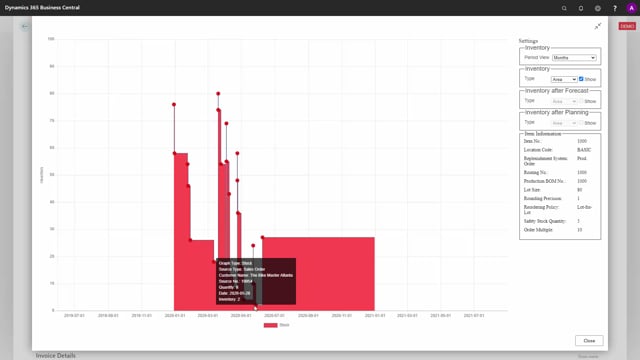
To see the full picture for an item, you can use the graphical profile, which is a free app. When you look at the profile without including assigned quantity, you see the complete supply and demand situation for the item.
In the example here, the item has a minimum of two and an ending inventory of 27. The profile includes firm planned production orders, but it could just as well have included purchase orders, inbound transfer orders, or assembly orders. The point is that you choose which supply to include, and for everything to work out perfectly, those supplies need to arrive on time.
What happens when a supply is delayed
Take a scenario where one of the supplies is delayed. For instance, firm planned production order 145 with a quantity of 50 might be delayed because some components are late. It could also have been a purchase order delayed in quantity or time.
When you enter the firm planned production order and change the date, you create a problem for the sales orders that were counting on that supply. If you look at the inventory profile before reassigning the sales order lines, you see issues on a lot of sales orders. With other apps it is possible to calculate and move those sales orders, but with the assigned quantity app you can at least remove the assignment.
If you look at the inventory profile including assigned quantity right after moving the supply, the picture is now wrong. You have moved a supply and done nothing else, so the assigned quantity on the sales order lines is no longer correct.
Using the reassignment report
To fix the incorrect assignments, you use the reassignment report. Some customers run this report as a daily or nightly batch job to reassign again and again. You can decide for yourself how often you need it.
In this example, the report runs on a single item and location filter, just to delete all the soft assignments and reassign them. It calculates in the order of the sales orders, taking the first entered sales order first, and so on.
When you look at the graphical profile afterwards and include assigned quantity, the assigned quantity should not drop below zero. But you can also see that the inventory is now 7 instead of 27. That means quite a lot of sales orders were not assigned in this scenario, so many sales orders did not get any quantity.
Finding the sales orders that lost their quantity
To see which sales orders missed out, look at the inventory profile without including assigned quantity. There you can find the sales orders that did not get any quantity and figure out what to do with them.
This gives you a practical way to handle delayed supplies or quantity changes. You reassign what you can, and you get a clear list of the sales orders that need attention.
Q&A
What supply types can you include in the assigned quantity?
You can include firm planned production orders, purchase orders, inbound transfer orders, and assembly orders. You choose which supply types to include in the calculation.
What happens to the assigned quantity when a supply is delayed?
The assignment becomes incorrect. If you move or delay a supply and do nothing else, the assigned quantity on the sales order lines no longer matches reality, so you need to reassign.
How do you correct the assignments after a supply is delayed?
You use the reassignment report. It deletes the soft assignments and reassigns them, calculating in the order of the sales orders and taking the first entered sales order first.
Can you run the reassignment automatically?
Yes. Some customers run the report as a daily or nightly batch job so the assignments stay correct. You decide how often you need it.
How do you find the sales orders that did not get any quantity?
Look at the inventory profile without including assigned quantity. There you can identify the sales orders that received no quantity and decide what to do with them.