
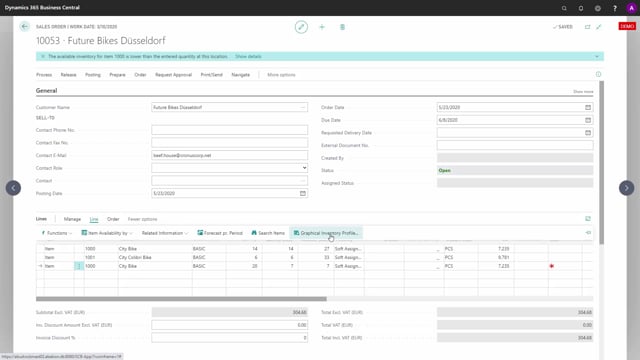


When you work with available-to-promise calculations in Business Central, the assign quantity feature gives you a realistic answer to how much you can actually deliver on a given date. Instead of relying on manual reservations, it calculates mathematically how much inventory remains available across the whole timeline, taking all other demands into account.
If you enter a sales order line for 20 pieces but other orders already commit your stock, the system might assign only seven pieces. It does this because it will not let inventory drop below zero within the relevant period.
You can use the Graphical Inventory Profile, a free app, to visualise what happens on the line and understand why a specific quantity was assigned.
How assign quantity finds the best match in a sales order
When you use assign quantity, the system always tries to find the best suitable match for your customer based on the date you enter on the sales order line.
Say you enter a sales order line with item number 1000 and a delivery date in March, with a quantity of 20. The system might assign only seven pieces. That number is not arbitrary. It reflects what is genuinely available once all other demands are accounted for.
Why standard reservation makes promised quantities complex
If you used normal reservation in standard Business Central, you would reserve supply and demand against each other. That means some of your existing demands would already be tied to the supply that came in before them.
This gets complicated quickly. To free up those reservations and make sure everybody still gets what you promised them, you would have to unwind a chain of commitments. It is hard to keep track of and easy to break promises by accident.
How the calculation handles inventory across the timeline
Assign quantity takes a different approach. Instead of reserving line by line, it calculates mathematically what is still possible to deliver from inventory.
In the example, the sales order on the March date would theoretically push inventory to minus eight. That is not acceptable, so the system does not assign the full 20. When you look at the inventory profile including the assigned quantity, you can see that only seven pieces were assigned. Within the two-month period, inventory cannot go below zero, and there is another sales order further out that already brings inventory down to zero.
The result is that assign quantity works out exactly what is possible and assigns the best amount it can without overcommitting your stock.
Using the Graphical Inventory Profile to understand the result
The Graphical Inventory Profile is a free app that helps you see what is happening on a sales order line. You can view all the demands on a given date and see how inventory develops over time.
By turning on the option to include the assigned quantity, you can see directly why the system assigned the number it did. This makes it much easier to explain to a customer or a colleague why a sales order line was assigned seven pieces rather than the requested 20.
Q&A
Why does assign quantity assign fewer pieces than I requested on a sales order?
Because the system calculates how much inventory remains available across the whole timeline, including all other demands. If delivering the full quantity would push inventory below zero within the relevant period, it assigns only the amount it can genuinely deliver.
How is assign quantity different from standard reservation in Business Central?
Standard reservation ties specific supply to specific demand line by line, which becomes complex to unwind when you need to free up stock. Assign quantity instead calculates mathematically what is still possible to deliver from inventory, without locking individual supply and demand together.
How can I see why a specific quantity was assigned?
Use the Graphical Inventory Profile, a free app. It shows all the demands on a given date and how inventory develops over time. Turn on the option to include the assigned quantity to see exactly why the system assigned the number it did.