


If you manage inventory in Business Central and need to keep stock separated by customer, campaign, or agreement, you can use a global dimension as an inventory filtering dimension. This lets you assign quantity per dimension value, so the same physical location can hold stock reserved for different purposes.
You enable this in the Assign Quantity setup by checking “Assign using dimension 1” or “Assign using dimension 2”. Once enabled, the assignment respects the dimension filter and only assigns quantity that is actually available for that dimension value. This prevents negative inventory per dimension.
The dimension filtering works as a light reservation tool on top of the assignment functionality. It applies in the graphical inventory profile, in assigned quantity, and in flexible forecast and reverse planning if you use those apps.
Using a global dimension to filter inventory per customer or campaign
With the assigned quantity functionality, it is possible to assign per dimension value. This means you can take one of your global dimensions and use it as an inventory filtering dimension, then use the dimension value to filter your stock.
That way it becomes possible to handle inventory on the same location split by, for instance, different customer, different customer chain relation, different campaign, or agreement. You do not need separate locations to keep the stock apart.
How negative inventory per dimension occurs
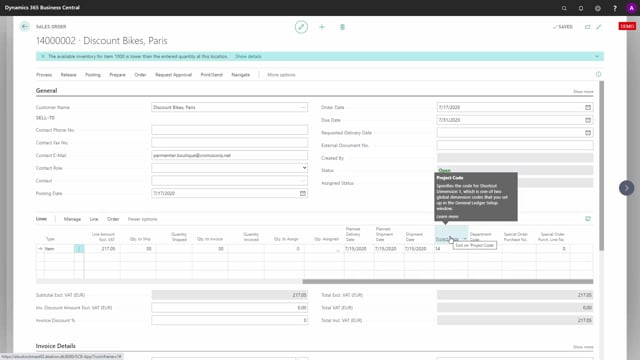
Take a sales order line as an example. If you enter 30 as quantity, the system assigns 30, and the available quantity shows as 56 across the location as a whole.
The sales order line also carries a project code, which is one of the global dimensions. In this setup it is global dimension 1, called project code, with a dimension value of 14. It could just as easily have been a campaign code.
If you open the graphical inventory profile and apply a project filter so you only look at dimension value 14, the picture changes. You can see that there is stock on inventory for dimension value 14, but there are also demands, sales orders, tied to that same dimension value.
The result is a negative inventory for that specific dimension value. The total location stock looks fine, but the stock allocated to dimension value 14 has been oversold. This is what you want to avoid.
Enabling dimension filtering in the Assign Quantity setup
To prevent this, go into the Assign Quantity setup. In the assigned quantity functionality you can choose to assign using dimension 1 or dimension 2. When you check “Assign using dimension 1”, the system applies a dimension filter when it performs the assignment.
Back on the sales order line, the difference is clear. When you now enter a quantity of 30, the system only assigns 9, because 9 is what is actually available for that dimension value. If you look at the graphical profile again with the dimension filter applied, the inventory now goes to zero instead of negative.
Using dimension values as a light reservation tool
This gives you a way of using a dimension value as a light reservation tool on top of the assignment tool. For example, if you run a Christmas campaign and buy a thousand units to put on stock specifically for that campaign, you can use a dimension value to keep those thousand units earmarked for it.
The behaviour applies in several places. It works through the graphical inventory profile tool, it applies to assigned quantity, and if you also use the apps for flexible forecast and reverse planning, it applies there as well.
Q&A
How can I keep inventory separated by customer or campaign without using separate locations?
Use one of your global dimensions as an inventory filtering dimension and assign quantity per dimension value. This lets the same physical location hold stock allocated to different customers, customer chains, campaigns, or agreements.
Why am I getting negative inventory for a specific dimension value?
The total stock on a location can look sufficient while the stock allocated to a single dimension value, such as a project or campaign code, has been oversold. The demands tied to that dimension value exceed the inventory tied to it, which produces a negative inventory per dimension.
How do I stop the system from assigning more than is available per dimension value?
In the Assign Quantity setup, check “Assign using dimension 1” or “Assign using dimension 2”. The system then applies a dimension filter during assignment and only assigns the quantity that is actually available for that dimension value.
Where does the dimension filtering apply once it is enabled?
It applies in the graphical inventory profile, in assigned quantity, and in the flexible forecast and reverse planning apps if you use them.