
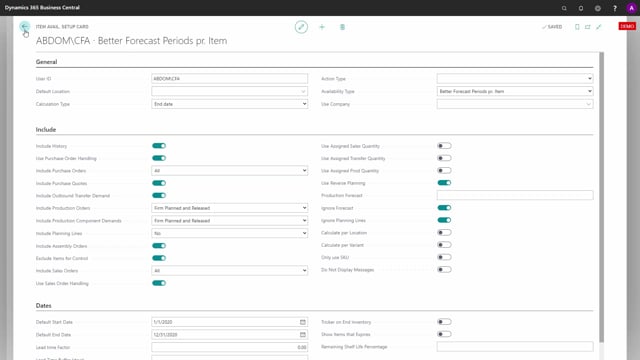


The Graphical Inventory Profile in Business Central saves your settings per user ID. When you change parameters on the request page, such as deselecting Include History, Business Central remembers your choice the next time you run the profile.
You find these settings in two places. The Item Availability Setup table stores settings per user, while the Item Availability General Setup table holds a single shared setup that applies when no user-specific setup exists.
The Graphical Inventory Profile shares the same calculation engine with three other apps: Reverse Planning, Assign Quantity, and Flexible Forecast (sometimes referred to as Better Forecast). This is why each user can have multiple setup lines, one per availability type.
Because the setup is stored per user, you can look up a colleague’s user ID and inspect their settings to understand why they get the results they do. This makes it easy to support other users.
How settings are saved on the request page
When you open the Graphical Inventory Profile, a request page appears where you can change parameters. For example, you can deselect Include History. When you run the profile again, Business Central remembers that you deselected Include History. This setting is saved per user ID in your Business Central environment.
Where to find the Item Availability Setup
The full setup behind this functionality is fairly complex. To find it, search for “item availability setup”. You get two results: an Item Availability General Setup list and an Item Availability Setup.
If you open the Item Availability Setup, you see the user ID on the left-hand side. A single user can have several setup lines tied to their user profile. The availability type on each line determines which app the line belongs to:
- Graphical Inventory Profile
- Reverse Planning, which is a separate app
- Assign Quantity, which is another separate app
- Flexible Forecast, which is the app sometimes called Better Forecast
All four apps use the same base calculation engine, which is why their setup lines appear together and are saved automatically.
Editing the setup on the Item Availability Setup card
The line for the Graphical Inventory Profile corresponds to the profile you are working with. If you navigate into the Item Availability Setup card for the graphical item availability, you see all the settings for that profile in one place.
Here you can find the Include History field that you deselected on the request page and select it again if you want. You can also adjust other settings such as purchase handling and change the configuration to fit your needs.
Using the per-user setup to support colleagues
Because the setup is stored per user in this table, it gives you a clear overview when you help other users. If a colleague calls and does not understand why they get a particular result, you can find their user ID, open their availability setup, and see which check marks they have enabled. From there you can explain why they get the result they are seeing.
The Item Availability General Setup and shared settings
The Item Availability General Setup works differently. It is not tied to a user ID, so it holds only a single line. Business Central uses this line when there is no user-specific setup.
This general setup is also used by apps that require a common configuration across all users. For example, the Assign Quantity app requires everybody to use the same setup, so its settings are taken from this table rather than from individual user setups.
Q&A
Where does Business Central store Graphical Inventory Profile settings?
Settings are stored per user ID in the Item Availability Setup table. Each user can have several setup lines, one for each availability type. You find the table by searching for “item availability setup”.
Which apps share the Item Availability Setup?
Four apps share the same base calculation engine and store their setup in this table: Graphical Inventory Profile, Reverse Planning, Assign Quantity, and Flexible Forecast (also referred to as Better Forecast).
What is the difference between Item Availability Setup and Item Availability General Setup?
Item Availability Setup is stored per user ID, so each user can have their own lines. Item Availability General Setup is not tied to a user and holds a single line. Business Central uses the general setup when no user setup exists, and for apps such as Assign Quantity that require everybody to use the same configuration.
How can I see why a colleague gets a specific availability result?
Open the Item Availability Setup, find your colleague’s user ID, and look at their setup line. You can see which check marks they have enabled and explain why they get the result they are seeing.