
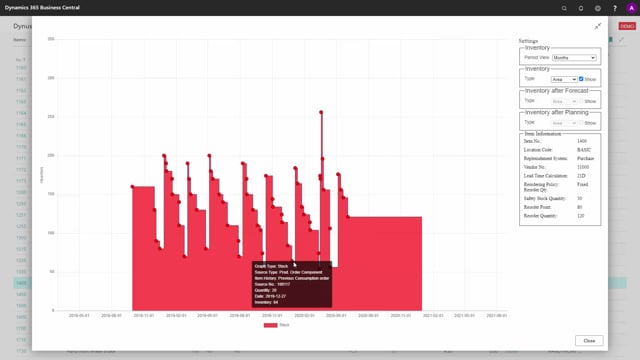


The graphical inventory tool in your Microsoft business solution gives you a visual profile of each item’s inventory over time. You use it to balance two goals that normally pull in opposite directions: raising your service level and lowering your inventory bindings.
You can see at a glance whether an item’s inventory is steady or has high deviation. A steady profile means you can safely lower the safety stock without hurting your service level. A profile with high deviation and peaks close to zero means you should keep the safety stock high, especially for important items where running out of stock is costly.
For example, if a front wheel never drops below 30 in stock and the profile is steady, you can often lower the safety stock from 30 to 15 and keep the same service level. For a finished bike that occasionally drops close to zero, a higher safety stock makes sense.
The classic conflict between service level and inventory bindings
Most inventory planning comes down to a balancing act. You want a high service level so you never run out of stock, but you also want to keep your inventory bindings as low as possible. These two goals work against each other, and finding the right balance for each item is where the graphical inventory tool helps.
The tool gives you a visual profile of each item, so you can understand how that item actually behaves before you decide on its safety stock.
Reading an item’s inventory profile
From an item, you open the graphical view directly. By including history, you see how the inventory profile has looked over time and what you can expect going forward.
Take a front wheel as an example. The history shows the lowest inventory is normally 30, and the profile is very steady. If you expect the future to look the same, with no more deviation than you can already see, you can ask a useful question: is a safety stock of 30 still necessary, or could you lower it to 15 and keep the same service level?
When the profile is steady, the answer is usually that you can lower it. A steady item with little deviation gives you room to reduce the safety stock without taking on real risk.
Spotting items with too much safety stock
The real value comes when you work through your full item list. You click an item, look at its graphical profile, and immediately see whether it is steady or volatile. Some items stand out right away with a high safety stock that the profile does not justify.
This makes it easy to investigate items one by one during a planning discussion. You move from item to item, look at each graphical view, and decide whether the safety stock matches the item’s actual behaviour. An item with only a little deviation is a clear candidate for a lower safety stock.
When to keep a high safety stock
Not every item should have its safety stock reduced. Top-level items behave differently. A finished bike, for instance, often shows much higher deviation, with peaks that come close to zero. In one case the inventory drops to one.
If that item is important and you cannot afford to run out of stock, then a profile that occasionally dips low is acceptable, and you keep the higher safety stock. The point is to match the safety stock to the item’s importance and its real demand pattern, not to cut inventory everywhere.
Getting an overview of inventory and service level
Used across your items, the graphical inventory tool gives you a clear overview of both your inventory bindings and your service level. Instead of guessing, you base each decision on how the item has actually behaved, which makes it far easier to optimise inventory item by item.
Q&A
What does the graphical inventory tool show?
It shows a visual profile of each item’s inventory over time, including history, so you can see whether the inventory is steady or has high deviation. This helps you balance service level against inventory bindings.
How do I know if I can lower an item’s safety stock?
Look at the graphical profile. If the item is steady with little deviation and never drops below a comfortable level, you can usually lower the safety stock and keep the same service level. For example, a front wheel that never falls below 30 could often run on a safety stock of 15.
When should I keep a high safety stock?
Keep a high safety stock for important items with high deviation, where the inventory occasionally drops close to zero. A finished bike that dips to one in stock is an example where running out of stock is too costly to risk.
How do I use the tool when optimising many items?
Click each item and open its graphical view. The profile shows immediately whether the item is steady or volatile, so you can decide item by item whether the safety stock matches the actual demand pattern.