
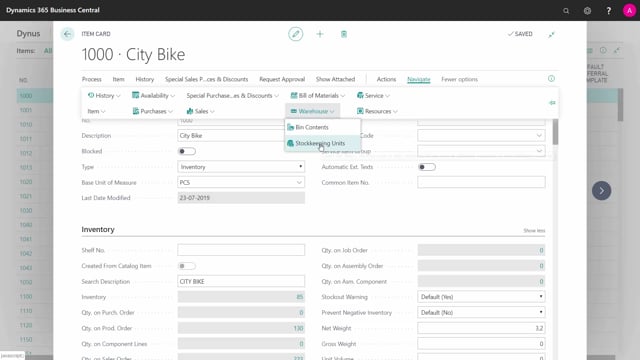


Stock keeping units in Business Central let you control item parameters at the level of a specific location or variant. You set them up when an item needs different planning parameters, prices, or replenishment settings depending on where it is stored or which variant it is.
You do not need to create a stock keeping unit for every location. If no SKU exists for a location, Business Central uses the default information from the item card. This keeps your data clean and reduces the amount you need to maintain.
You can create and view stock keeping units in three ways: through the item card under Navigate, Warehouse, Stock Keeping Units, through the Create Stock Keeping Unit action with a guided wizard, or directly from the Stock Keeping Units list in the menu.
When to use stock keeping units instead of the item card
An item card holds the default settings for an item. But sometimes you need those settings to differ depending on the location where the item is stored or the variant of the item. A stock keeping unit (SKU) gives you that flexibility.
Typical reasons to set up a SKU include different planning parameters, different prices, or other item parameters that need to vary between locations or variants. In this setup, the item card sits at the top, and below it you can define a separate SKU for each location with parameters that differ from the item card.
You only need SKUs where the data actually differs
Creating a SKU for every item and every location means creating and maintaining a lot of data. In practice, you can skip the SKU on locations where the default information from the item card is fine. When no SKU exists for a location, Business Central falls back to the item card automatically. So you only build SKUs where you genuinely need to deviate from the defaults.
Three ways to access stock keeping units in Business Central
You can reach your SKUs in a few different ways, depending on what you are doing.
- From the item card: Open an item, for example item 1000, and go to Navigate, Warehouse, Stock Keeping Units. This shows a list of the existing SKUs on that item, where you can also create new ones and open the SKU card.
- From the Actions menu: Use the Create Stock Keeping Unit function. This opens a small wizard that helps you create new stock keeping units more easily.
- From the menu search: Search for the Stock Keeping Units list directly. This gives you a full list of all SKUs, including the item, and you can sort it by location or by item number.
What the stock keeping unit card contains
When you open a SKU card, it defaults a lot of values from the item card. The flow fields, such as inventory quantities, react to the specific location and variant, so the figures you see are for that exact combination.
If you scroll down the card, you can set up different parameters for that location or variant, including prices, replenishment parameters, and planning parameters. Everything you set here applies to that specific location, variant, or the combination of the two, while leaving the item card defaults untouched for everywhere else.
Q&A
What is a stock keeping unit (SKU) in Business Central?
A stock keeping unit is a record that lets you define item parameters such as prices, planning parameters, and replenishment settings for a specific location, a specific variant, or a combination of both. It overrides the defaults from the item card for that location or variant.
Do I need to create a SKU for every item and location?
No. You only need a SKU where the settings must differ from the item card. If no SKU exists for a location, Business Central automatically uses the default information from the item card.
How do I create a stock keeping unit in Business Central?
You can create a SKU from the item card under Navigate, Warehouse, Stock Keeping Units, through the Create Stock Keeping Unit action which opens a guided wizard, or directly from the Stock Keeping Units list in the menu.
What happens to the item card values when I open a SKU card?
The SKU card defaults many values from the item card. The flow fields react to the specific location and variant, and you can override parameters such as prices, replenishment, and planning settings for that combination without changing the item card defaults.