
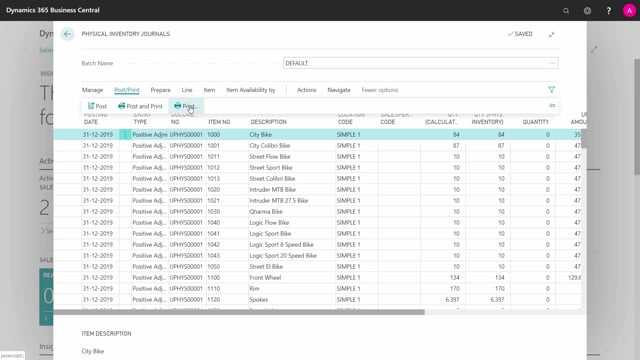


If you run inventory counts in Business Central, the Physical Inventory Journal is where you record what you actually have on the shelf and let the system post the difference against what it expected. This article walks through how the journal works for standard inventory locations, how to print count sheets, and how to handle items that use Item Tracking with Lot or Serial Numbers.
The Physical Inventory Journal is the right tool when you use standard inventory functionality without directed put-away and pick. If you run warehouse locations with that functionality, you use other journals instead.
To start a count, you use the Calculate Inventory function in the journal. Business Central fills in the quantity it believes is in stock. You can only enter the counted quantity. The calculated quantity field is locked, so you cannot accidentally overwrite the system’s expected figure.
For items with Item Tracking, you enter Lot or Serial Numbers when there is a difference to post. If the line quantity is zero, no Item Tracking is needed. If you are short, you select the existing Lot Number for the missing pieces. If you have more than expected, you enter the Lot Number for the extra units, which adds that lot to inventory.
When to use the Physical Inventory Journal
If you want to perform annual or half-annual counts on your inventory, you use the Physical Inventory Journal for normal locations without warehouse functionality. For warehouse locations, you use other journals, which we cover separately.
The Physical Inventory Journal is where you can make all kinds of corrections to your inventory. So if you are not using directed put-away and pick, but just the standard inventory functionality, this is the journal you enter.
Calculating the expected inventory
When you are doing an annual count, you go into the Prepare action and calculate your inventory. Here you set the Posting Date.
You can check a box to add items that are not currently in your inventory. If you leave it unchecked, the journal only creates lines for items that actually should be in stock. The function then calculates the quantity that Business Central believes is in your inventory.
All lines default to Positive Adjustment, and the counted quantities are left blank. Note that you cannot type in the quantity field, and you cannot edit the calculated field. You can only enter the counted field, for example the 84 pieces someone counted.
Printing count sheets for your staff
After calculating, you may want to print the journal so people can go out and count the physical stock. You go into Post and Print, and choose Print.
You decide whether to show the people doing the count the calculated quantity or not. This matters: should they count what is actually there without knowing what should be there, or should they see the expected figure first? Counting blind gives you a cleaner check, while showing the expected number is faster.
You can also choose to show existing Serial and Lot Numbers, so staff can count per Serial or Lot Number. You can preview the report before printing.
The printed sheet lists all the items with the calculated quantity and a line where staff can write the actual quantity by hand. If you enabled it, the report also includes Lot Number and Serial Number specifications for items handled with Item Tracking.
Entering counted quantities and posting
Once the sheets come back, you enter the counted quantities. For example, you may have counted 85 bikes instead of the expected figure, or 86 of another item instead of 87.
Business Central automatically fills in the quantity and sets the entry type to a positive or negative adjustment depending on what you enter, along with the difference. The line is then ready to post.
Handling items with Item Tracking
For items with Item Tracking, the way you handle Lot and Serial Numbers depends on the difference.
If the calculated quantity is 870 and you count 870, the line quantity is zero. When you open the Item Tracking Lines, there is nothing to track, because the line does nothing.
If the calculated quantity is higher than what you counted, for example 886 when you are short, you go into Item Tracking and select the relevant numbers. The system shows that it requires Item Tracking for the missing pieces, for example two pieces. You select the corresponding Lot Number. If there is only one lot, this is simple. Once the undefined quantity is zero, the line is ready to post.
If on another location you count more than expected, for example five extra pieces, you go to the Item Tracking Lines where the undefined quantity is now five. You enter the Lot Number for those five pieces that have shown up, which adds that lot to inventory.
This way you fill in what is actually counted, for both standard items and Item Tracking items, and then post the journal.
Checking the result on the item
After posting the annual count, you can look at the item to confirm the result. The adjusted figures show up, for example 85 and 86 pieces. For a Lot-tracked item like the Fruit Mix, you can see the new total, for example 883 pieces, spread across different locations and Lot Numbers that you entered during the count.
Q&A
When should I use the Physical Inventory Journal instead of warehouse journals?
Use the Physical Inventory Journal for counts on normal inventory locations without directed put-away and pick. If your location uses warehouse functionality, you count with other journals instead.
Can I edit the calculated quantity in the Physical Inventory Journal?
No. The quantity and calculated fields are locked. You can only enter the counted quantity, which protects the expected figure from accidental changes.
How do I count items that are not currently in inventory?
When you run Calculate Inventory, check the box to include items that are not in stock. If you leave it unchecked, the journal only creates lines for items that should be in inventory.
Should I show staff the expected quantity on the count sheet?
You can choose either option. Hiding the calculated quantity forces a blind count, which gives a cleaner check. Showing it is faster but lets the expected figure influence the count.
How do I handle Lot Numbers when the count shows a difference?
If you are short, open the Item Tracking Lines and select the existing Lot Number for the missing pieces until the undefined quantity is zero. If you have extra pieces, enter the Lot Number for those units, which adds that lot to inventory.