
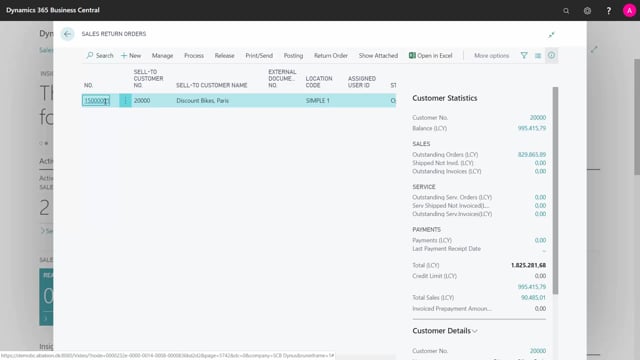


A sales return order in Microsoft Dynamics 365 Business Central is a sales document you use to handle items a customer sends back to you. It works the same way as a regular sales order, which means you can post the receipt of the items and the invoicing as two separate steps.
When you post the receipt on a sales return order, the items go back into your inventory and the system creates item ledger entries for each line. The quantity to invoice then remains open so the finance department can handle the credit side separately.
You enter the quantities you expect to receive in the Return Qty. to Receive column on the order lines before posting the receipt.
What a sales return order is in Business Central
A sales return order is a sales order in reverse. Instead of sending items to a customer, you receive items back from the customer, for whatever reason that has been agreed. It carries the same functionality as a standard sales order, so you can handle the physical movement of goods and the financial side independently of each other.
In practice, this means you can post the receipt of the returned items first, and then deal with the invoicing later. The two transactions do not have to happen at the same time.
Setting up the return lines
A typical sales return order starts when someone in your business agrees with a customer that specific items can be sent back. On the return order you list the item lines and the quantities the customer is allowed to return.
In the example, the order has two item lines, each with a quantity that has been agreed with the customer.
Posting the receipt of returned items
The first transaction to handle is the physical receipt. When the items arrive back on your ramp, you go to the Return Qty. to Receive column and enter the quantity you are receiving for each line.
You then post the receipt the same way you post on many other documents in Business Central. Posting the receipt puts the returned items back into your inventory and creates an item ledger entry for each line. In the example, posting created two item ledger entries, one for each of the two lines.
Handling the invoicing separately
After you post the receipt, the quantity to invoice remains open on the order. This is the financial part of the return, and it is left for the finance department to handle. Because shipment and invoicing are separate steps, the warehouse can receive the goods without the credit being posted at the same moment.
Q&A
What is a sales return order in Business Central?
It is a sales order used to receive items back from a customer. It has the same functionality as a normal sales order, so you can post the receipt and the invoicing as separate transactions.
How do you receive returned items on a sales return order?
Enter the quantity in the Return Qty. to Receive column on each line, then post the receipt. This posts the items back into inventory and creates an item ledger entry for each line.
What happens to the invoicing after you post the receipt?
The quantity to invoice stays open on the order after the receipt is posted. This part is handled by the finance department as a separate step.
Can you handle the receipt and the invoice of a return at different times?
Yes. A sales return order lets you post the receipt of the items and the invoicing independently, so the goods can be received without the credit being posted at the same time.