
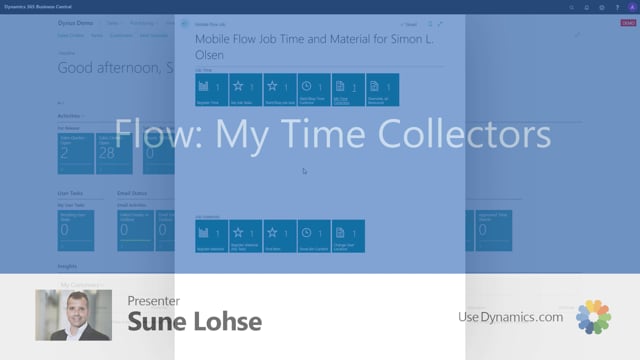


Time collectors in your Microsoft Dynamics 365 Business Central solution give you a structured way to register time and move it into the right journals. This article explains how the time collectors flow works, what the “process collected time” action does, and how you decide who should have access to it.
The time collectors flow gives you an overview of all your time collectors in one place. You can remove filters to see everybody’s time collectors, not just your own.
From the flow you can start and stop the time collection, change status, and manage resources. You also use it to process the collected time.
The “process collected time” action moves the time from the collected time column into the correct journal and over to the exported time column. This means the time you gather can be transferred automatically to the job journal or the timesheet.
Access to this page is something you should think about. You decide whether each resource can move their own collected time into journals, or whether that is a manager’s job.
Overview of all time collectors in one flow
In the time collectors flow you get an overview of every time collector. By default you see your own, but you can remove the filters and see everybody’s time collectors. This makes it easier to keep track of registered time across the team rather than checking each entry separately.
Starting, stopping and managing time collection
The flow is where you control the time collection. You can start and stop the functionality, change status, and handle the resources connected to the time. It works as the central point for managing the registration process.
Processing collected time into journals
The key action in the flow is “process collected time”. When you run it, the time moves from the collected time column into the correct journal and over to the exported time column. So once you have gathered up the time, it can be transferred to the job journal or the timesheet automatically. You do not have to copy the entries manually.
Deciding who gets access to the page
This is a page that not everybody should necessarily have access to. It is up to you to decide the setup. You can let each resource move their own collected time into the journals, or you can keep that step as a manager’s responsibility. Either way, it is a deliberate choice about who controls the final transfer of time.
Q&A
What does the “process collected time” action do?
It moves the time from the collected time column into the correct journal and over to the exported time column. The time can then be transferred automatically to the job journal or the timesheet.
Can I see other people’s time collectors?
Yes. By default you see your own, but you can remove the filters in the time collectors flow to see everybody’s time collectors.
Who should have access to process collected time?
That is up to you. You can decide whether each resource moves their own collected time into journals, or whether that task belongs to a manager.