
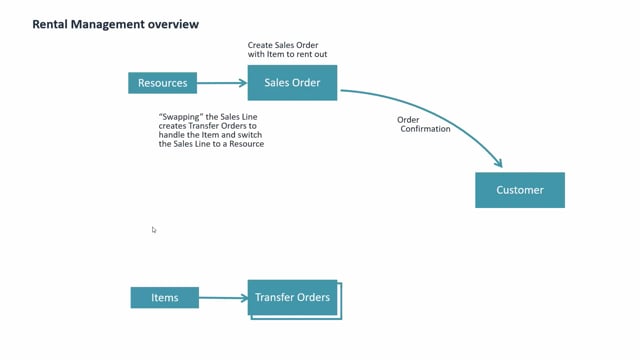


The rental management system for Business Central lets you rent out inventory items to customers, track them while they are out, ship and receive them back, and handle the invoicing. The system works by combining standard Business Central functionality: sales orders, transfer orders, and resources. When you confirm a rental order, the solution swaps the item sales line for a resource line that handles invoicing, and it creates transfer orders to move the physical item to and from the customer.
You ship items to the customer using a transfer order, and you can use the standard warehouse functionality, including inventory picks and warehouse shipments. When the customer is done, you receive the item back with a second transfer order. You invoice the customer from the sales order using a resource, and you can prolong the rental period with monthly invoicing as long as the items have not been returned.
What the rental management system does in Business Central
The rental management system for Business Central is built for companies that rent out their items to customers. In our examples we use a Segway, but the principle applies to any item you keep on inventory and lend out for a period.
The system covers the full cycle. You ship the items to the customer, keep track of them while they are out, receive them back, and invoice the customer for the rental. You can also prolong the renting period and keep billing the customer for as long as they hold the item.
How the rental process works
The process starts with a sales order that includes the item number you want to rent out. You send an order confirmation to the customer, discuss the terms and agreement, and wait for the customer to confirm.
When the customer confirms the order, the system swaps the sales line. This swap does two things:
- It creates transfer orders to handle the physical item using the item number.
- It switches the sales line to a resource instead, which is set up to handle the invoicing.
The transfer order and the sales order are linked together by a rental relational line. This line combines the two documents so you can handle them together as one rental.
Shipping items with transfer orders and warehouse functionality
You use the transfer order to handle and ship the items to the customer. If you use the warehouse functionality, you can also create an inventory pick or a warehouse shipment, depending on your setup. The items can be handled like normal item processes, just with a transfer order driving the movement.
Receiving items back and invoicing the customer
When the customer is done using the item, you receive it back with a second transfer order. It is also possible to set up only one transfer order and use the transit location, but normally you would use two transfer orders: one out and one back.
Once you receive the item back, you invoice the customer from the sales order using a standard resource. If the customer keeps the item longer, you can prolong the renting period and do monthly invoicing for as long as the items have not been received back.
Q&A
How does the rental management system create the invoicing line in Business Central?
When the customer confirms the order, the system swaps the item sales line and switches it to a resource. The resource is set up to handle the invoicing, while transfer orders handle the physical movement of the item.
How are the sales order and the transfer order connected?
They are linked together by a rental relational line that combines the two documents. This lets you handle the sales order and the transfer order together as one rental.
How many transfer orders do you need for a rental?
Normally you use two transfer orders: one to ship the item to the customer and one to receive it back. You can also set up a single transfer order using the transit location, but two is the standard approach.
Can you use warehouse functionality with rental transfer orders?
Yes. If you use the warehouse functionality, you can create an inventory pick or a warehouse shipment depending on your setup, and handle the items like normal item processes.
How do you handle invoicing when a customer keeps the item longer?
You can prolong the renting period and do monthly invoicing for as long as the items have not been received back. Final invoicing from the sales order happens using a standard resource once the item is returned.