


If you ship goods in containers and want to track the real cost of each shipment, you can assign freight, customs, insurance, and other expenses directly to a specific sales container in Business Central. You do this with the standard item charge functionality, combined with a sales container field on the purchase line.
Add the container code to the purchase line, then pull the posted sales shipment lines linked to that container into the item charge assignment. When you post the purchase document, the cost is split across the sales shipment entries as value entries.
Be aware of one limitation. These costs show up on the item ledger and value entries, but not on the statistics of the sales order documents. Microsoft only includes costs posted to the general ledger in those statistics. You can still see the costs on the value entries and analyse them in BI tools.
Assigning expenses to a specific sales container
Say you have a container holding shipments from three different sales orders, which produce three different sales shipments. You want to apply the freight, customs, or insurance costs for that container to the value entries of those shipments. You can do this from a purchase invoice or a purchase order.
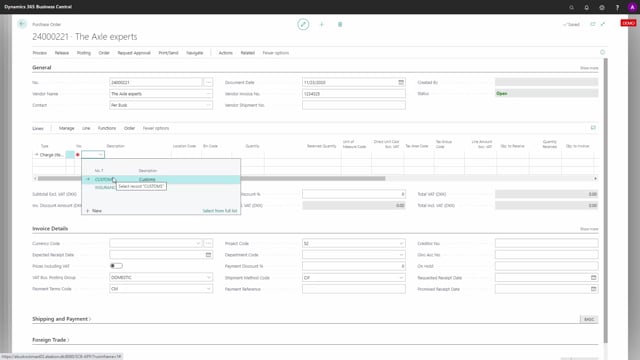
Open a purchase order for the expense you are buying, whether that is freight, customs, insurance, or any other cost tied to the container. Select the vendor number that delivers the expense. The vendor will typically send an invoice for it.
Using charge items on the purchase line
On the purchase line, select the type called Charge (Item). You can set up a list of different charge items in advance, for example customs, insurance, or freight, and adjust the description on the line as needed. In this example, the charge is one piece of freight covering the cost related to the specific container.
Linking the purchase line to the sales container
To split the cost per container, add the container code to the purchase line. Use the sales container field on the purchase line and select the related container.
After that, open the item charge assignment. From there, get the posted sales shipment lines for the container ID you added to the purchase line. This grabs all the sales shipment lines linked to that container.
You can then suggest the item charge assignment using the standard functionality and post it on the purchase order. The cost is split across the different sales shipment entries as value entries.
Checking the result on the sales shipment
To verify the impact, go to the sales container and navigate to one of the sales shipments. From the sales shipment, open the item ledger entries. Drill down on an item ledger entry to see the value entries connected to it.
There you will find the freight line you posted, with the cost assigned to that specific line.
Limitation on order statistics
These assigned costs do not currently appear on the statistics of the order documents. Microsoft only applies costs posted to the general ledger when calculating those statistics. The costs are still visible on the value entries, so you can run analytics on them and view them in different BI tools.
Q&A
How do I assign freight or customs costs to a specific sales container in Business Central?
Create a purchase order or purchase invoice with a charge item line for the expense, add the container code to the line using the sales container field, then open the item charge assignment and pull in the posted sales shipment lines for that container. Suggest the assignment with the standard functionality and post. The cost is split across the sales shipment entries as value entries.
Why don’t the assigned container costs show up on the sales order statistics?
Microsoft only includes costs posted to the general ledger in the statistics on the order documents. The assigned charge costs land on the value entries instead, so they do not appear in the order statistics.
Where can I see the costs I assigned to a sales container?
Open the sales shipment, go to the item ledger entries, and drill down on an entry to see its value entries. The freight or other charge cost appears there. You can also use the value entries for analytics and view them in BI tools.
What line type do I use on the purchase order to assign a cost to a container?
Use the Charge (Item) type on the purchase line. You can define a list of charge items in advance, such as customs, insurance, or freight, and adjust the description per line.