
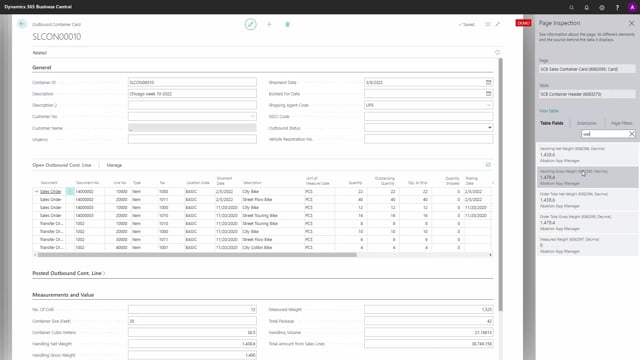


When you work with shipping containers in Microsoft Dynamics 365 Business Central, you can let the system calculate weight, volume, and packages automatically, but you can also override every value manually. The system stores both the calculated values and your manual entries side by side, so nothing gets lost.
You can adjust the number of colli, container size, cubic meters, net weight, gross weight, measured weight, the number of packages, and the volume. This is useful when you actually measure a shipment and the real figures differ from what the system calculated.
On the container line, the system keeps the handled weight and the order total weight as separate fields. The order total weight, order total packages, and order total volume are calculated automatically, and your manual additions sit on top of those calculations.
Calculating and entering measurement data manually
The container function calculates information based on measurements and value, but you are not locked to those calculations. You can add the data manually instead, or combine the two.
You can enter the number of colli by hand, and you can add the container size and cubic meters the same way. If you are bundling several items together into combined packages, you can set the actual number of packages to match what you are really shipping.
If you have the option to measure the volume, you can enter that too. The same goes for the net weight and gross weight.
Adjusting weight when you measure the shipment
The measured weight gives you a place to record what you actually weigh. The total measured weight works much like the total gross weight when you measure the shipment yourself. You enter the figure in whatever unit you work in, whether that is kilos or tons.
As an example, if you measure the gross weight and get a result of 1,400, you simply type 1,400 into the field. The value you enter replaces the calculated figure for that line.
How calculated and manual values are stored together
Even after you enter values manually, the calculated information stays in place. If you open the container line and search for weight, you will see that Business Central stores both the handled weight and the order total weight.
The order total weight, along with the order total packages and order total volume, is calculated by the system. You then add your manual figures on top and save everything. This means you always have both the system’s calculation and your real-world measurement available.
Q&A
Can you override the calculated weight and volume on a container in Business Central?
Yes. The system calculates weight, volume, and packages based on measurements and value, but you can change the net weight, gross weight, measured weight, number of packages, container size, cubic meters, and volume manually.
Are manual entries stored separately from the calculated values?
Yes. The container line stores both the handled weight and the order total weight. The order total weight, packages, and volume are calculated by the system, and your manual entries are added on top, so both sets of figures are saved.
What units can you use when entering measured weight?
You enter the measured weight in whatever unit you work in, such as kilos or tons. The total measured weight functions much like the total gross weight when you measure the shipment yourself.