
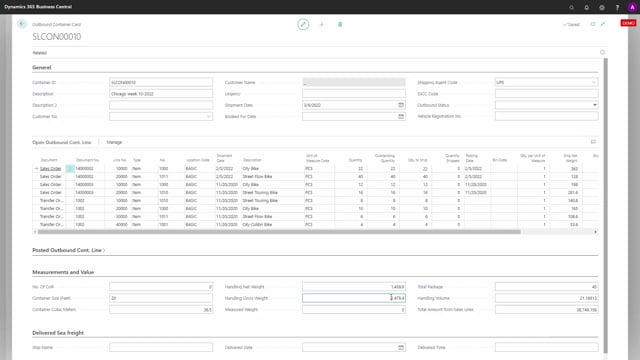


When you ship goods in containers in Microsoft Dynamics 365 Business Central, you can have the system calculate net weight, gross weight, number of packages, and volume automatically. The calculation uses the dimensions and weights you set up on the item’s units of measure, pulling the values from the sales order lines or transfer order lines in the container.
You set up height, width, length, net weight, and gross weight on the unit of measure on the item card. The cubage is calculated automatically from height, width, and length, so you don’t enter it manually.
There is no unit of measure handling on these dimension and weight fields. You must use the same SI unit consistently across all items. Pick either meters and kilos or inches and pounds, and use the same choice everywhere in your system.
Calculating measurements and values on the container
On the container, you can calculate measurements and values directly. The function calculates the net weight, the gross weight, the number of packages, and the volume based on information from the sales order lines or transfer order lines that are in the container. That information comes from the item.
Setting up dimensions on the item’s unit of measure
To set this up, you go to the item card and open the unit of measure. On the unit of measure you enter the height, width, length, and net weight. These are all standard columns.
The cubage is calculated automatically. If you change the width to 20 centimeters, for example, the cubage is recalculated for you.
We have added the gross weight as a column here as well, so you can distinguish between net weight and gross weight when calculating volumes.
Keep the same unit consistent across all items
All this information should be entered in the same SI unit. You shouldn’t enter centimeters on some items, inches on others, and meters on others again. There is no unit of measure handling on these fields, so the system won’t convert between them.
Select, for instance, meters and kilos, or inches and pounds, or whatever suits you. Then apply that choice consistently throughout your system.
Setting up measurements per unit of measure code
You can set this up per unit of measure code. If you have a box containing 10 items, you can set up the measurements for that box separately. This lets you handle the dimensions and weight of a packed unit rather than only the individual item.
Q&A
What can the container function calculate in Business Central?
It calculates net weight, gross weight, number of packages, and volume. The calculation is based on information from the sales order lines or transfer order lines in the container, which in turn comes from the items.
Where do you set up the dimensions and weights used for the calculation?
You set them up on the unit of measure on the item card. There you enter height, width, length, net weight, and gross weight.
Do you have to enter the cubage manually?
No. The cubage is calculated automatically from height, width, and length. If you change one of those values, the cubage is recalculated.
Does the system convert between different units of measure for dimensions and weights?
No. There is no unit of measure handling on these fields. You must use the same SI unit consistently, for example meters and kilos or inches and pounds, across all items in your system.
Can you set up measurements for a packed box rather than a single item?
Yes. You can set up measurements per unit of measure code. If you have a box containing 10 items, you can enter the measurements for the box.