
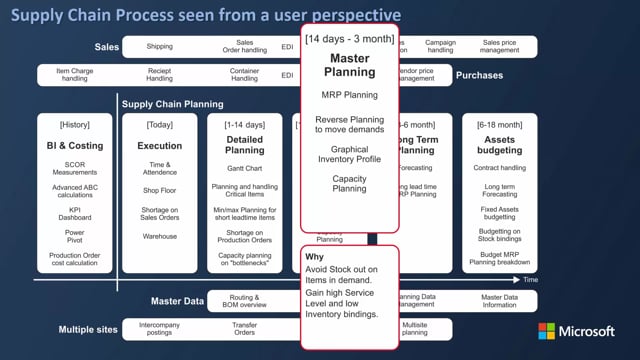


Master planning covers the time horizon from about two weeks to three months ahead. You use it to organise both production orders and purchase orders for the coming months. Detailed planning handles how each specific order is produced, and long-term planning breaks down requirements over a longer horizon. Master planning sits between the two and focuses on the overall puzzle of orders for the next couple of months.
The goal of master planning is to avoid stockouts, start production orders in an orderly way, achieve a high service level, and keep inventory bindings low.
What master planning is and where it fits
Master planning normally covers a horizon of around two weeks to three months, depending on your company and how you plan. It works differently from the two other planning levels:
- Detailed planning is about puzzling together all the specific orders and deciding how you want to produce them.
- Long-term planning is about breaking down requirements.
- Master planning is about the next couple of months and how to put together the overall puzzle of production orders.
Master planning for production and purchasing
Master planning applies to both production orders and purchase orders. The purchaser plans after the master production planner has done their part. The master purchase planner then needs to confirm all the purchase orders and make the changes required to get the goods on stock at the right time.
Why master planning matters
Master planning helps you avoid stockouts and start production orders in an orderly way. Done well, it lets you reach a high service level while keeping inventory bindings low. That balance is the reason master planning matters for both manufacturing and purchasing.
Q&A
What time horizon does master planning cover?
Master planning normally covers a horizon of around two weeks to three months, depending on your company and how you plan.
How does master planning differ from detailed and long-term planning?
Detailed planning is about puzzling together specific orders and deciding how to produce them. Long-term planning is about breaking down requirements. Master planning sits between them and focuses on the overall puzzle of production orders for the next couple of months.
Does master planning cover purchasing as well as production?
Yes. Master planning applies to both production orders and purchase orders. The purchaser plans after the master production planner, confirming purchase orders and making the changes needed to get goods on stock on time.
What is the goal of master planning?
The goal is to avoid stockouts, start production orders in an orderly way, achieve a high service level, and keep inventory bindings low.