


The planning worksheet in Microsoft Dynamics 365 Business Central lets you calculate demand for your manufactured and purchased items and turn that demand into actual supply orders. When you place a sales order on a top-level item, the planning worksheet breaks the demand down through your manufacturing hierarchy, all the way to the purchase orders you need to send to your vendors.
Use the planning worksheet when you work with manufacturing. If you only plan purchase items and don’t need to break down a bill of materials hierarchy, the requisition worksheet is enough.
To create supply, you run Calculate Regenerative Plan (the total plan), accept the resulting action messages, and carry them out. Business Central then creates the purchase orders and production orders automatically and removes the lines from the worksheet.
Setting up an item hierarchy for planning
To show how the planning worksheet works, start with a simple item hierarchy. At the lowest level there’s an Alu Rim, which is a purchase item. The Alu Rim goes into two manufactured items, the Alu Front Wheel and the Alu Back Wheel. Both of those wheels go into the bill of materials for the finished bike, the City Bike Alu.
The sales orders are placed on the top-level item, the City Bike Alu. From there, the goal is to calculate the demand for the lower-level purchased items so you know how many Alu Rims to buy.
Calculating the plan in the planning worksheet
Open the planning worksheet and run Calculate Regenerative Plan to generate a total plan. You need to enter a few parameters before the calculation runs:
- A starting date and ending date for the planning period
- Whether to include forecast in the calculation
- A location filter, if you want to plan for a specific location
With those settings in place, the worksheet calculates the complete plan for all items on the chosen location. The calculation can take a while, since MPS and MRP planning is a complex piece of functionality.
How the planning lines are ordered
When the calculation finishes, the worksheet shows all the planned items. They are sorted in low-level code order, which means the top-level items appear first. It can look like the lines are sorted by item number, but if you scroll down you’ll find items with smaller numbers further down the list. Those are the purchase items at the bottom of the hierarchy.
Each planning line shows the item number, whether it’s a purchase item or a manufactured item, and the suggested quantity based on the planning setup you’ve defined. For the Alu Rim purchase item, for example, you get a single planning line with the quantity Business Central suggests you buy.
Accepting and carrying out action messages
For each planning line you want to act on, set the check mark in the Accept Action Message field. Then run Carry Out Action Message. Before you do, you define what should happen for each type of order. In the case of a purchase item, you choose to create purchase orders.
When you carry out the action messages, Business Central removes the line from the planning worksheet and creates the actual order. For the Alu Rim, that means a new purchase order is created automatically.
Checking the created purchase order
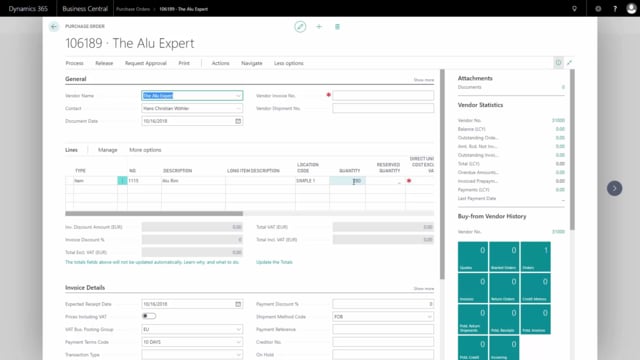
Go to your purchase orders to see the result. Sort the list in descending order to find the most recently created order at the top. The new purchase order shows the vendor, the Alu Rim, and the quantity from the planning line. It’s ready to send to the vendor.
Q&A
What is the difference between the planning worksheet and the requisition worksheet?
Use the planning worksheet when you work with manufacturing, because it breaks demand down through a bill of materials hierarchy. The requisition worksheet only plans purchase items and does not break down hierarchies.
What parameters do I need to enter to calculate a plan?
You need a starting date and an ending date for the planning period. You can choose whether to include forecast, and you can add a location filter to plan for a specific location.
In what order are the planning lines sorted?
The lines are sorted in low-level code order, so top-level items appear first and purchase items at the bottom of the hierarchy appear further down, even if they have lower item numbers.
How do I turn a planning line into a purchase order?
Set the check mark in the Accept Action Message field on the line, define that you want to create purchase orders, and run Carry Out Action Message. Business Central removes the line from the worksheet and creates the purchase order automatically.
What happens to the planning line after I carry out the action message?
The line is removed from the planning worksheet and Business Central creates the actual order, such as a purchase order ready to send to the vendor.