


If you manage multiple jobs in Business Central, you can invoice them all at once using the Create Job Sales Invoice batch job. This saves you from creating each invoice manually, one job at a time.
You find the batch job in two places: from the Jobs list under Process, choose Create Job Sales Invoice. You can also use the search function from anywhere in the system and select Create Job Sales Invoice.
When you run the batch job, you set the posting date and choose whether to create one invoice per job or one invoice per job task.
You can filter on job numbers if you only want to invoice a specific range. If you use the same job task structure across your jobs, you can filter on job task number too. This lets you invoice the same task type across all your jobs at the same time, for example a task you use for expenses.
The batch job creates separate invoices per job and per customer, so each customer gets their own invoice. You should review each invoice before posting and keep your job data clean so the invoices come out right.
How to start the batch job for job invoicing
The batch job that handles invoicing across multiple jobs is called Create Job Sales Invoice. You can reach it two ways:
- From the Jobs list, go to Process and choose Create Job Sales Invoice.
- Use the search from anywhere in the system and choose Create Job Sales Invoice.
It does not matter which way you open it. Both routes open the same prompt where you set up the invoicing.
Setting posting date and invoice grouping
In the prompt, you first set the posting date that should apply to the created invoices.
Then you choose how to group the invoices. You can create one invoice per job, or one invoice per job task. This controls how detailed the split is on the resulting sales invoices.
Filtering on job number and job task number
If you leave the filter fields blank, the batch job includes all jobs and all job tasks across all dates in the created sales invoices.
You can narrow it down with filters:
- Job number: set a filter if you only want to invoice a specific range of jobs.
- Job task number: if you use the same job task structure on all your jobs, you can filter on a specific task. This is useful when you build jobs from a template, because the task numbers match across jobs.
Filtering on job task number lets you invoice one specific task across all your jobs at once. For example, if you have a task for expenses, you can invoice just the expenses across every job in one run.
When the setup is ready, click OK. The system tells you how many invoices were created. In this example, five invoices were created across the jobs.
Reviewing the created invoices before posting
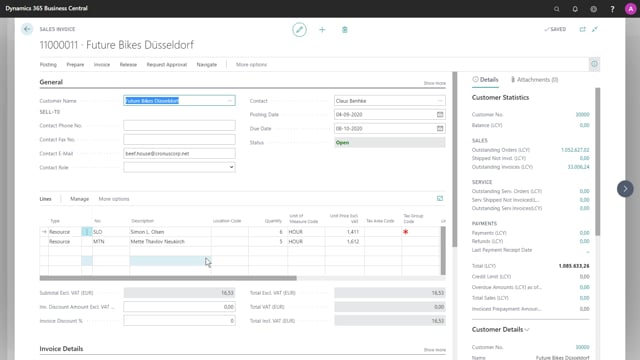
After the batch job runs, go to Sales Invoices to see the result. The batch job creates separate invoices split by job number and customer number. In the example, five different invoices were created.
You can open each invoice to see what will be invoiced. You can make changes directly on the invoice, and you can add extra lines if something is not registered on the job.
It is usually better to handle everything on the job itself rather than editing the invoice afterwards. That way you keep the full overview on the job card and your data stays consistent between the job and the invoice. Make sure you have control over your data on both the job and the invoice before you post.
Q&A
Where do I find the batch job for invoicing multiple jobs in Business Central?
It is called Create Job Sales Invoice. You can open it from the Jobs list under Process, or use the search from anywhere in the system and choose Create Job Sales Invoice. Both routes open the same prompt.
Can I invoice several jobs at the same time?
Yes. The Create Job Sales Invoice batch job lets you create invoices across a range of jobs in one run. You can choose one invoice per job or one invoice per job task.
What happens if I leave the filter fields blank?
All jobs and all job tasks across all dates are included in the created sales invoices.
Can I invoice only a specific job task across all jobs?
Yes, if you use the same job task structure on all your jobs. Set a filter on the job task number, and the batch job invoices that specific task across every job at once. This works well when you build jobs from a template.
How are the invoices split when the batch job runs?
The batch job creates separate invoices by job number and customer number, so each customer gets their own invoice.
Should I edit the invoice or the job when something is missing?
You can add extra lines directly on the invoice, but it is usually better to handle everything on the job. That keeps the full overview on the job card and your data consistent.