
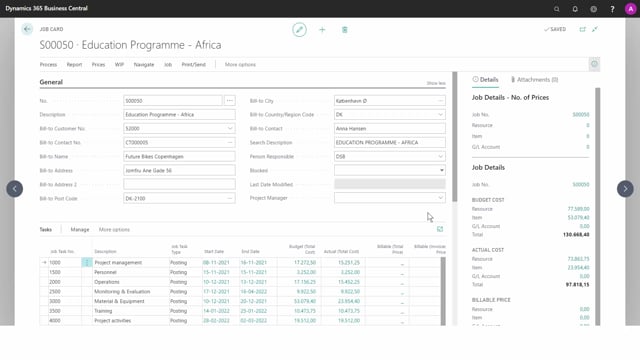


In Business Central you can set up job-specific prices directly on a job, so you control the price for one particular project without changing your general price setup. This is useful when you are not using customer price groups but still want a special price for one customer on one project.
You can define prices in three areas on the job: G/L accounts, resources, and items. This article focuses on item prices.
You can set a price down to the individual job task, or leave the job task number blank to make the price valid for the whole job. A blank value always means the line covers all types.
You can define a fixed unit price, an agreed line discount, or a unit cost factor where the customer pays cost plus a markup. For a 20% markup you enter the factor as 1.20.
What job-specific prices are and when to use them
On a job in Business Central you have the option to set up prices that apply only to that job. You might use this if you are not working with customer price groups, but only want to set a price for one specific project for a customer.
There are three different ways to set up prices on the job: for G/L accounts, for resources, and for items. The principles are the same across all three, and here we look at item prices.
Setting prices per job task or for the whole job
There are a couple of different ways to define your prices. You can define a price down to the individual job task, or you can define a price that is valid for the whole job by leaving the job task number blank.
This is the general rule across all of these fields: if you leave a value blank, it covers all types. A blank job task number means the price is valid for all job task numbers on the job.
Setting a specific unit price on an item
If you want to set up a price on a specific item, you choose it from the item list. For example, you could choose the Street Sport bike, which has a normal unit price of 5,999.00, and define a project-specific unit price of 5,000 for this job.
You can also define specific setups for the unit of measure, so the price applies to a particular unit.
If the price is only valid for a specific currency, you enter the currency code. If you are using local currency, you leave the currency code blank.
Using line discounts and unit cost factors
You do not always need to set a fixed unit price. For another item, such as the Street Touring bike, you might not want to give a specific unit price on the job, but instead an agreed discount.
You can also set up a unit cost factor if you want the customer to pay a markup on the cost. For example, on item 1011 you can say that the customer should pay cost plus 20%. Since it is a factor that is multiplied onto the amount, you write it as 1.20.
Q&A
What does a blank job task number mean on a job price line?
It means the price is valid for all job task numbers on the job. Leaving a value blank always covers all types, while entering a specific job task number limits the price to that task.
When should I use job-specific prices instead of customer price groups?
Use job-specific prices when you are not working with customer price groups but want to set a price that applies only to one specific project for a customer.
How do I make a customer pay cost plus a markup on a job?
Set up a unit cost factor on the item. The factor is multiplied onto the cost, so to charge cost plus 20% you enter the factor as 1.20.
What types of prices can I set up on a job in Business Central?
You can set up prices for G/L accounts, resources, and items. For items you can define a fixed unit price, an agreed line discount, or a unit cost factor.
What do I enter in the currency code field for job prices?
Enter the currency code if the price is only valid for a specific currency. Leave it blank if you are using local currency.