
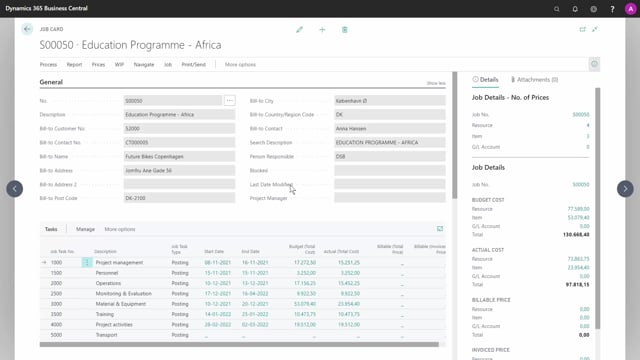


In Microsoft Dynamics 365 Business Central, you can set up specific prices on a job that determine what you invoice to the customer. The job price types are G/L account, resource, and item.
For G/L account prices, you set up lines on the job. Each line can specify a job task number, a G/L account, a currency code, a unit cost factor, and a line discount.
If you leave the job task number blank, the price applies to all job task numbers. If you fill it in, the price applies only to that specific task.
You use the unit cost factor to add a markup. A factor of 1.30 multiplies the cost by 1.30, which adds 30% to the cost. You use the line discount field to reduce the price shown on the customer invoice, for example a 10% discount.
Setting up G/L account prices on a job in Business Central
On a job, you have the option to set up specific prices that you want to invoice to the customer. The system gives you three price types: G/L account, resource, and item. This article covers the G/L account type.
You set up the prices in a table on the job, tied to the job number. There is no fixed limit to how many prices you can define. It comes down to how many lines you add.
How the job task number controls the scope of a price
One important thing to understand is how the job task number works. If you leave the job task number blank on a line, the price is valid for all job task numbers. If you enter a specific job task number, the price only applies to that task.
G/L account prices are often used when you want to specify expenses such as travel, accommodation, or food that you want to invoice to the job customer.
Adding a unit cost factor to mark up the price
For each price line you can select the relevant G/L account and define a currency code. If you work in local currency, you can leave the currency code blank.
In most cases you will want to add a unit cost factor. The factor is multiplied onto the cost. For transport, for example, you can set a unit cost factor of 1.30. That multiplies the cost by 1.30 and adds 30% to it.
Adding a line discount to reduce the invoiced amount
You can also add a line on a different job task number with a line discount. This is useful when there are costs on material, equipment, or similar accounts that you want to invoice at a reduced rate.
As an example, you can set up a price on job task 5000 so that anything posted with G/L account 25100 gets a unit cost factor applied. On job task 3000, you can set up a line for account 32015 that gives a 10% line discount. The discount is then shown on the customer’s invoice.
Q&A
What does it mean if I leave the job task number blank on a job price line?
If you leave the job task number blank, the price is valid for all job task numbers. If you enter a specific job task number, the price applies only to that task.
What price types can I set up on a job in Business Central?
You can set up three price types: G/L account, resource, and item.
How does the unit cost factor work on a job price?
The unit cost factor is multiplied onto the cost. A factor of 1.30 multiplies the cost by 1.30, which adds 30% to it.
Where does the line discount on a job price appear?
The line discount is shown on the customer’s invoice. For example, a 10% line discount on a specific G/L account reduces what the customer is charged for postings on that account.
When should I use G/L account prices on a job?
G/L account prices are often used to specify expenses such as travel, accommodation, or food that you want to invoice to the job customer.