
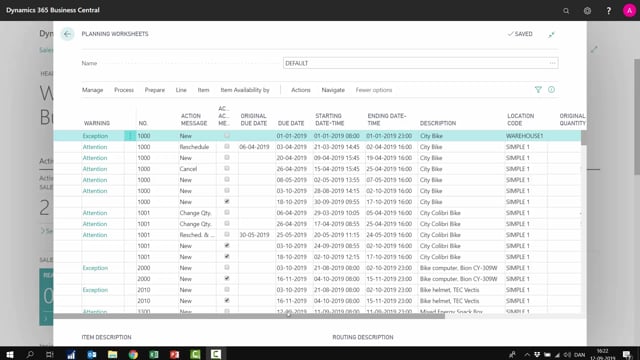


When you run material requirements planning in Microsoft Dynamics 365 Business Central, the system calculates everything that needs to be purchased, produced, assembled, or transferred in the same batch job. You only split the calculation if you manually set filters when selecting which items to plan.
If you run a complete MRP plan, all the supply types are calculated at the same time. The planning worksheet plans in low-level code order, which means the reference order type gets mixed throughout the result rather than grouped neatly by type.
You can plan purchase orders separately at the end, because purchase items have no components below them and do not affect the planning of other items. You cannot meaningfully separate production planning from the rest, because production orders sit at different levels in the item hierarchy.
How the planning worksheet calculates all supply types together
Calculating items to purchase, to produce, to assemble, or to transfer is done in the same batch job. The exception is if you manually set filters when you select the items to plan. But if you run a complete MRP plan, all of these are calculated at the same time.
In a planning worksheet where you have calculated a complete plan, you can scroll right to see the reference order type for each line. You might see the first line as reference order type Transfer, meaning it came from a stock keeping unit card. The next line could be an item with a production order, followed by purchase items, assembly items, and then a production order again.
Why low-level code order mixes the reference order types
The example above shows that you can easily have purchase items on higher levels than other production orders. That depends on your item hierarchy, because the planning engine plans in low-level code order.
The consequence is that the reference order type gets mixed into the planning. It would be tidier if the system did all production order planning first, then all purchase order planning, and so on. But because planning follows the low-level code, the supply types end up interleaved.
When you can split out purchase order planning
The one thing you can run separately, if it makes sense for your setup, is purchase order planning. You can do that at the end of the process. Purchase orders have no components below them and they have no effect on the planning of other items, so they can be planned last as a separate planning job.
Q&A
Does Business Central calculate purchase, production, assembly, and transfer in the same batch job?
Yes. When you run a complete MRP plan, all four supply types are calculated in the same batch job at the same time. The only way to split the calculation is to manually set filters when you select the items to plan.
Why are the reference order types mixed in the planning worksheet?
The planning engine plans in low-level code order, following the item hierarchy. This means purchase items can appear on higher levels than production orders, so the reference order types end up interleaved rather than grouped by type.
Can I plan purchase orders separately from the rest of the MRP run?
Yes. Purchase order planning is the one part you can run separately at the end. Purchase orders have no components below them and do not affect the planning of other items, so they can be handled as a separate planning job.