
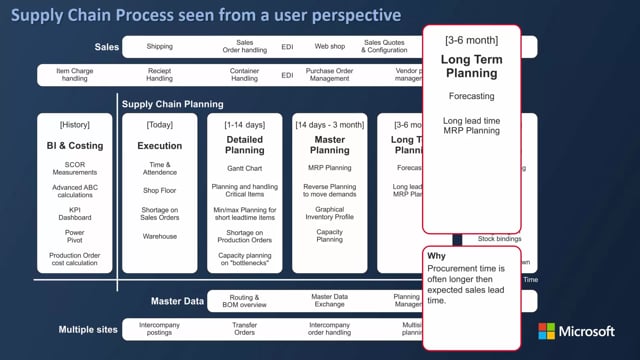


Long-term planning lets you cover requirements that stretch from three months out to several years ahead. You typically use it for items with long lead times, such as goods shipped from the other side of the world that can take six months or more to arrive. You break down a sales forecast using MRP planning to figure out what to buy now so your requirements are met far into the future.
The main challenge is noise. If you run the standard MRP batch job and generate firm planned orders for the long horizon, you flood the master planners’ workspace with orders they don’t need yet. The solution is to find a way to capture the long-term data without disturbing the master planners, who work on a much shorter horizon.
What long-term planning covers and why you need it
Long-term planning normally covers everything beyond three months from now, sometimes stretching several years ahead. You need it when you handle items with long lead times. Think of goods that come from far away, perhaps the other side of the world. You often have to order them in bulk, ship them in, and wait six months or even longer before they arrive.
Production items behave differently. They usually have a shorter lead time because you can speed up the process yourself. That difference in lead time is exactly why purchased items with long delivery times need their own planning approach.
How planners use a sales forecast to drive purchasing
As a planner, you often need to make agreements with vendors or place orders well ahead of time. To do that, you break down requirements based on a sales forecast. Someone responsible for sales gives you an expected forecast for the coming year, and you translate that into purchasing decisions.
You use MRP planning or other tools to answer one question: what should I buy now to fulfil my requirements for the long term ahead? When you handle the long-term ordering, the items arrive in stock, and the master planners can then do their master planning with the materials already available.
The noise problem in long-term planning
The risk in long-term planning is noise. If you simply run the normal MRP batch job and create a lot of firm planned orders for the long horizon, the master planners end up with a cluttered planning picture. They see a large number of orders that have nothing to do with their immediate work.
Master planners typically operate on a much shorter horizon than the purchaser handling long lead-time items. So as a purchaser, you need to find a way to capture the long-term data you need without generating noise in the master planners’ workspace.
Q&A
What time frame does long-term planning cover?
Long-term planning normally covers everything beyond three months from now, and it can stretch up to several years ahead.
Which items need long-term planning?
Items with long lead times, such as goods sourced from far away that can take six months or more to arrive. Production items usually have shorter lead times because you can speed up the process yourself, so they don’t require the same long horizon.
How do you decide what to buy for the long term?
You break down a sales forecast provided by the sales-responsible person, then use MRP planning or other tools to calculate what you should buy now to meet your requirements far into the future.
Why does the standard MRP batch job cause problems for long-term planning?
Running the normal MRP batch job creates a lot of firm planned orders for the long horizon. This floods the master planners’ workspace with orders they don’t need yet, because they work on a much shorter horizon. The result is unnecessary noise in their planning.