
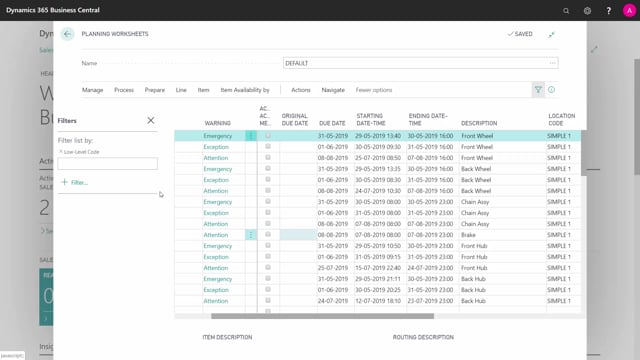


Master planning in Microsoft Dynamics 365 Business Central lets you split the work between a production master planner and a purchase master planner. You can use the planning worksheet to plan production orders level by level, starting from the top-level item and working down through the low-level codes. This gives you control over each stage and lets you check capacity before you commit.
You filter on the low-level code to handle one level at a time. Start with low-level code 0 (the top level), adjust the suggested quantities, then carry out the lines as firm planned production orders. Each time you change a higher level, you replan the levels below it so the quantities stay correct.
When you have planned all production levels, you hand the plan over to the purchaser. The purchaser removes the low-level code filter, changes the replenishment system to purchase order, and runs the plan to get the suggested purchase orders.
You run the full plan across all low-level codes for a specific reason: it gives you a correct capacity overview per level. If you only plan one level, the capacity picture for the top level is wrong because the lower levels may share the same work centres.
Splitting planning between the production and purchase master planner
The scenario here is that a production master planner does the low-level planning in the planning worksheet, and then hands the result over to the purchase master planner. The purchase planner then handles purchasing within the master planning period.
The idea is that one person owns the production side and plans it level by level, and the plan they produce becomes the input for purchasing. The production plan covers the detailed planning for the production people, and the firm planned orders feed into the long-term planning for purchases.
Calculating the plan in the planning worksheet
Start by going into the planning worksheet and calculating a plan. In this example the planning period runs from 1 June to September, and you calculate only production orders. You calculate across all low-level codes rather than one code at a time. There is a reason for that, which comes down to the capacity overview later.
After calculating, you see the planning lines. If you scroll right you can see the details, for example the front wheel and back wheel with low-level codes for 140 pieces.
Planning level by level using the low-level code filter
The approach is to work top-down through the low-level codes, one level at a time.
First, filter on low-level code 0, which is the top level. Then change the suggested orders as needed. In this example, the first order is changed to 50 because marketing is running a big campaign, and similar changes are made on the next two lines.
Before carrying out the lines, check the capacity. You should look at what the capacity planning looks like in those periods for those orders. Is it possible to make three orders like this? This is also why you need the rest of the lines in the worksheet at the lower levels, because they share capacity entries that affect the overall picture.
You can show the planning flexibility column and lock lines if you want to keep them fixed during the next replan. Whether you use planning flex and locking is up to you.
When the top-level lines look right, carry out the action messages as firm planned production orders.
Replanning lower levels after changing the level above
Once you change the level 0 quantities, the quantities on the levels below are no longer correct. So you replan, then filter on the next low-level code.
Filter on level 1 and below, taking all the levels from 1 downward so you can still do capacity planning. If you scroll right you can see the quantities have changed. Lines that were 140 are now something else because of the changes you made on level 0.
Filter on level 1 alone, handle those lines, make any new changes, move dates, look at capacities, lock lines if you want, then carry out to firm planned orders.
Continue the same way: clear the low-level code filter, recalculate, and move down to the next level. In this example you move to low-level code 2 and below, still only production orders, because you are acting as the production master planner. Filter on level 2, handle the remaining lines, check capacity, and carry out. In this journal there are no demands on level 3.
The result of the level-by-level production plan
When you finish, all your firm planned orders for the period are planned from the top level down in a way that makes sense. You get a list of firm planned orders, and you can draw out the capacity needs on the dates you expect them. You can then hand this over to the purchasers.
Handing the plan over to the purchaser
The purchasers can now plan all purchase items by going into the plan. They remove the low-level code filter, change the replenishment system to purchase order, and run the plan. The result is all the suggested purchase orders they need.
Why you run the full plan across all low-level codes
The reason for running the full plan, rather than just one level, is to get a correct capacity overview per low-level code. If you want a clean capacity overview on level 0, you also need some kind of suggestion for the demand and capacities on the lower levels. The lower levels often use the same work centres, so leaving them out would give you a wrong capacity picture.
Q&A
How do you split master planning between production and purchasing in Business Central?
The production master planner plans the production orders level by level in the planning worksheet and carries them out as firm planned orders. This plan becomes the input for the purchase master planner, who handles purchasing within the master planning period.
How do you plan one level at a time in the planning worksheet?
Filter on the low-level code, starting with code 0 for the top level. Adjust the suggested quantities, check capacity, then carry out the lines as firm planned production orders. After changing a level, replan and filter on the next level down, repeating until all levels are handled.
Why do you need to replan the lower levels after changing the top level?
When you change the quantities on level 0, the demand on the levels below changes too. Replanning recalculates the lower-level quantities so they reflect the new top-level orders.
How does the purchaser turn the plan into purchase orders?
The purchaser removes the low-level code filter, changes the replenishment system to purchase order, and runs the plan. This generates the suggested purchase orders for all purchase items.
Why calculate the plan across all low-level codes instead of one level?
Running the full plan gives you a correct capacity overview per low-level code. Because lower levels often use the same work centres, leaving them out would produce a wrong capacity picture for the top level.
How can you keep a planning line fixed during replanning?
Show the planning flexibility column and lock the line. Locked lines stay fixed when you recalculate the plan. Whether you use planning flexibility and line locking is optional.