


If your planning worksheet keeps generating too many lines for orders you have already committed to, you can lock those orders so the planning engine leaves them alone. The setting that controls this is the Planning Flexibility field in Business Central. Set it to “None” on a supply order line, and MRP will no longer reschedule or cancel that line.
Planning Flexibility works on transfer order lines, purchase order lines, assembly order lines, and production order lines. By default every line is set to “Unlimited”, which means the planning engine is free to change it.
Locking lines reduces the number of changes you have to handle in the planning worksheet. Be aware that it can also lead to extra orders or excess stock, because the engine creates a new supply order when it cannot reschedule a locked one.
Why lock supply orders in planning
When you run MRP in Business Central, the planning worksheet can produce a large number of planning lines. Some of those lines suggest rescheduling or cancelling orders that you have already locked in for a good reason. To avoid getting too many planning lines in your journals, you can lock the orders you don’t want the planning engine to touch.
Here is a concrete example. In the planning worksheet, calculating the plan with a filter on item 1000 produces six lines. The engine wants to reschedule one line and cancel another, creating a new production order in the process. In this case the second and fourth lines are set to change. If you are happy with those orders and they are already committed in some way, you don’t want them touched.
How to lock an order with the Planning Flexibility field
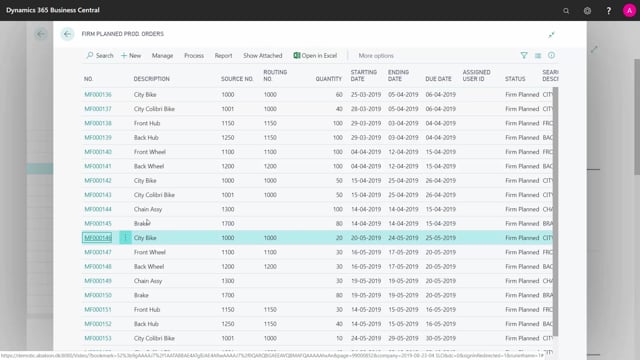
To lock specific orders, go to your firm planned production orders and find the orders you want to protect. In the example, that is order number 163 and order number 146.
The field that controls this is Planning Flexibility. It is probably not shown in your version of Business Central, even if you are running a premium license. You need to use personalisation to add the field to the order lines yourself. Once you have added it, you can see the value, which defaults to “Unlimited”.
Set the field to “None” on the lines you want to lock. This tells the planning engine it can no longer plan that line. Do this on both order 163 and order 146, and the two orders are now locked. MRP should not be able to find them anymore.
What changes when you run the plan again
Run the plan again after locking the two orders. Instead of creating six lines, it now creates four. The quantities are also a little different, because the engine now takes into account that it is not cancelling and not rescheduling the locked lines.
The risk of locking planning lines
Locking lines comes with a risk you need to be aware of. If a demand has moved beyond a supply date and the engine cannot reschedule the existing order because it is locked, it will simply create a new order instead. This can lead to re-planning or to too many items in stock. Use the Planning Flexibility field deliberately and keep an eye on the results.
A practical way to control planning load
Used carefully, Planning Flexibility is a nice way to keep down the load of changes in the planning worksheet. Because it applies to transfer order lines, purchase order lines, assembly order lines, and production order lines, you can lock down committed supply across the whole supply chain and let MRP focus on the lines that still need to move.
Q&A
How do I stop the planning worksheet from rescheduling a specific order?
Set the Planning Flexibility field on the order line to “None”. The planning engine will then no longer reschedule or cancel that line.
Why can’t I see the Planning Flexibility field on my order lines?
The field is not shown by default, even with a premium license. Use personalisation to add the field to the order lines, and then you can change its value.
Which order types support Planning Flexibility?
Planning Flexibility applies to transfer order lines, purchase order lines, assembly order lines, and production order lines.
What is the risk of locking planning lines?
If a demand moves beyond a supply date and the engine cannot reschedule the locked order, it creates a new order instead. This can result in re-planning or excess stock, so use the setting deliberately.
What is the default value of the Planning Flexibility field?
The default value is “Unlimited”, which lets the planning engine freely change the line.