
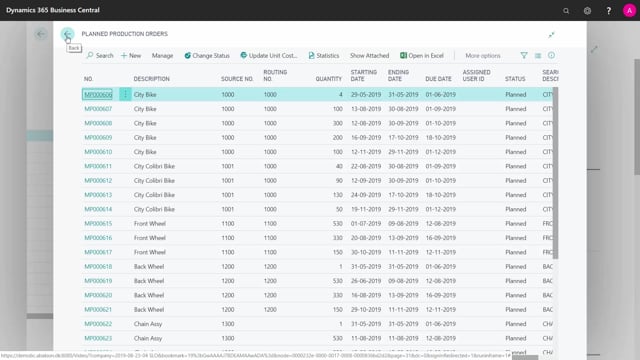


If you work as a purchaser in Business Central and need to plan further into the future than your production planners do, you face a practical problem. The planning worksheet your colleagues use for short-term master planning is shared territory, and you don’t want to disturb their plans. This article explains a method for doing long-term purchase planning by using planned production orders as the demand source, so you can plan purchases without interfering with the master and detail planners.
The key is to plan only on planned production orders rather than firm planned or released production orders. Planned production orders are deleted automatically the next time someone runs the plan, so they don’t leave permanent traces in the production planners’ work. This makes them a safe basis for the purchaser’s long-term horizon.
You set the starting date of your run to begin after your latest open firm planned or released production order. That way you keep the short-term planning untouched and only generate the planned orders you need for purchasing.
In the standard version you have to release the relevant orders manually, which can be tedious. There are apps available that speed up this checking and releasing step if you need a faster workflow.
Using planned production orders as the demand source for purchase planning
When you do long-term planning as a purchaser, the planning worksheet is the same one the master planning team uses for shorter periods. To avoid creating noise in their plans, you use your own approach in the planning worksheet to find the correct starting date.
You set that starting date after your latest open firm planned or released production order. From there you plan only on the replenishment system “production order” and break down the hierarchy from the sales level. This includes forecast and blanket orders if you use them, and all the production orders that create dependent demand for your purchase planning.
You check off the orders you want, then carry out action messages to create planned production orders rather than firm planned production orders. This generates a set of planned production orders in the background.
How planned production orders create demand for purchasing
Each planned production order carries a bill of materials, so the component lines create demand. When you then run your purchase planning, those component requirements drive suggestions for purchase orders.
The big advantage is that planned production orders are temporary. When someone runs the plan again, they are deleted automatically. This means your long-term planning layer doesn’t permanently affect the firm planned and released production orders that the master planners and detail planners rely on.
You can think of the split like this: planned production orders are for the purchaser’s long-term planning, while firm planned and released production orders belong to the master and detail planners.
Generating purchase orders from the planned orders
Once the planned production orders exist, you calculate the plan again so they generate demand for your purchase planning. When you run purchase planning for the same period, you plan only on purchase orders, but you let all the planned orders create the demand.
The result is a set of suggestions based on the planned orders you just created, and from there you can create vendor orders or purchase orders.
The manual step and how to speed it up
In the standard version, you have to do the checking and releasing manually before you carry out the action messages. This works, but it takes time when you have many orders. Apps from the app stores can give you a faster way to handle all of this if the manual process becomes a bottleneck.
Q&A
How can a purchaser do long-term planning without disturbing the master planners?
Use the planning worksheet to set a starting date after your latest open firm planned or released production order, and plan only on planned production orders. Because planned production orders are deleted automatically the next time the plan runs, they don’t interfere with the firm planned and released orders that the master and detail planners use.
Why use planned production orders instead of firm planned production orders for purchase planning?
Planned production orders create demand through their component lines, which drives your purchase planning. They are also temporary and get deleted automatically when someone runs the plan again, so they don’t leave permanent traces in the production planners’ work.
How do planned production orders generate purchase order suggestions?
Each planned production order has a bill of materials with component lines that create demand. When you run purchase planning, that demand produces suggestions, and you can create vendor orders or purchase orders from them.
Can the manual checking and releasing step be automated?
The standard version requires you to check and release the orders manually. Apps available on the app stores can speed up this step if you need a faster workflow.