


Demand forecasting in Microsoft Dynamics 365 Business Central lets you tell the MRP planning engine what you expect to sell in the future, so the system can plan supply before the actual sales orders arrive.
You enter the forecast as a production forecast with a quantity on a specific date. The forecast period runs from one forecast entry until the next entry for the same item. If you enter a forecast on 1 October and the next entry is in November, the October period runs until 31 October.
When you change a forecast quantity, Business Central creates a new forecast entry on the same date rather than overwriting the old one. The planning sums the entries together, so the result is the combined quantity for that date.
The MRP planning consumes the forecast against actual sales orders within each period. If sales orders in a period exceed the forecast, the forecast is fully consumed and contributes nothing extra. If sales orders are lower than the forecast, only the remaining difference is added as demand. The forecast guarantees a minimum level of demand for planning.
How forecast entries work in Business Central
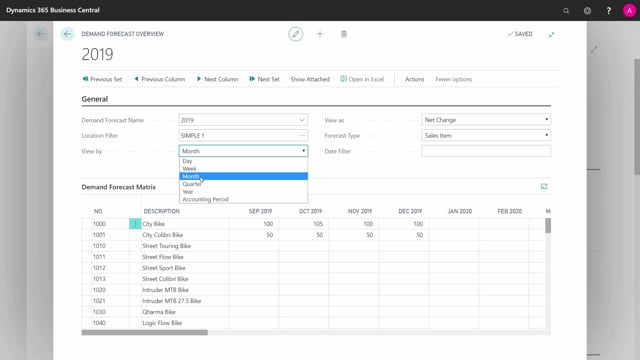
In Business Central you find the demand forecast under the production forecast. You can view it per whatever period you prefer, for example by month. A forecast with quantities entered in September, October, November and so on shows up as entries, each with a forecast date and a forecast quantity.
If you drill down into a single forecast entry, you see it is just an entry with a forecast date, for example 1 October, and a forecast quantity. When you change the forecast, for instance from the existing value to 105, and drill down again, you see that the system has created a new entry on the same date. The planning sums these up, so the result is 105 on 1 October. That total is the input for the MRP planning.
How the forecast period is defined
By default the forecast period runs from one forecast entry until the next one. If you have an entry in November, the October period runs until 31 October. A December forecast that has no later entry has no ending period.
You can add more forecast entries within the same span. If you add another entry of 23 pieces on 14 October, you change the period for the earlier 105 entry so it now runs from 1 October to 13 October. Adding entries this way subdivides the periods.
How MRP planning consumes forecast against sales orders
The MRP planning looks into each forecast period and compares the forecast quantity with the actual sales orders in that period.
Take an example with a forecast of 125 pieces entered on the first day of each month, and sales orders spread across the months. The planning looks at the period from 1 April to 30 April. In that period the sales orders total 130 pieces, which is more than the forecast of 125. Because demand already exceeds the forecast, the forecast entry for that period is not used in the planning. When actual demand matches or exceeds the forecast, the forecast adds nothing.
In the following month the sales orders are 80 pieces and 33 pieces, a total of 113. Since this is below the forecast of 125, the remaining forecast of 12 pieces is added as demand. All these resulting requirements are what the MRP planning batch job uses as input for the planning.
What the forecast actually does
The forecast makes sure you always have at least the forecast quantity as demand. If real sales orders cover the forecast, the system plans for the real demand. If sales orders fall short, the forecast tops the demand up to the forecast quantity. That way you start producing or purchasing before the actual orders come in.
Q&A
What happens when you change a forecast quantity in Business Central?
Business Central creates a new forecast entry on the same date instead of overwriting the existing one. The planning sums the entries together, so the combined quantity becomes the forecast for that date.
How is the forecast period determined?
The period runs from one forecast entry until the next entry for the same item. If you have an entry in November, the October period runs until 31 October. The last entry with no following entry has no ending period.
What happens if sales orders exceed the forecast in a period?
The forecast entry for that period is not used in the planning. The MRP planning uses the actual sales orders as demand instead, since they already exceed the forecast.
What happens if sales orders are lower than the forecast?
Only the remaining difference is added as demand. For example, with a forecast of 125 and sales orders totaling 113, the remaining forecast of 12 pieces is added to the planning.
What is the purpose of the demand forecast in MRP planning?
It ensures you have at least the forecast quantity as demand, so you can plan supply before actual sales orders arrive. Real orders consume the forecast, and any shortfall is topped up to the forecast level.