
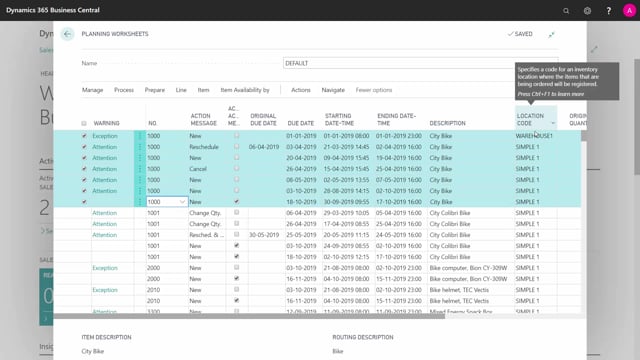


Material Requirements Planning (MRP) in Microsoft Dynamics 365 Business Central plans on three dimensions: per item, per location, and per variant. To read the planning worksheet correctly, you treat every combination of item, location, and variant as a separate plan. This is the single most common point of confusion for planners.
The planning worksheet processes items in order of their low-level code, starting with top-level items at low-level code zero. For each item, it calculates one location at a time, including variants where they are set up, before moving on to the next location and the next item.
How MRP plans per item, per location, and per variant
For an MRP batch job to make sense, the system plans per item, per location, and per variant. You can see this directly in the planning worksheet once you have calculated a complete plan.
Take item 1000 as an example. This is a top-level item on low-level code zero. In the worksheet you will find lines for the location Warehouse One and lines for other locations. Most of the data sits in one location, but if you scroll down, you see other items appear with increasing item numbers.
When you reach item 1120, for instance, you have the first item on low-level code one. The first line for that item is on the location Advanced. The system calculates everything for location Advanced on that item, including variants if you have set them up, and then it moves on to calculate the next location, and so on through all locations.
Why each item, location, and variant must be read separately
The mechanics matter, but the mindset matters more. In practice, the hardest thing for most planners to grasp is that the planning per item, per location, and per variant is to be understood completely separately.
You look at one item at a time. You plan one item at a time. You understand one item at a time. Each item, location, and variant combination is its own plan, and trying to read the worksheet any other way is where the confusion starts. Keeping this separation clear is the key to working confidently with the planning worksheet.
Q&A
What dimensions does MRP plan on in Business Central?
MRP plans on three dimensions: per item, per location, and per variant. Every combination of these is treated as its own separate plan.
In what order does the planning worksheet process items?
It processes items by low-level code, starting with top-level items at low-level code zero. For each item it calculates one location at a time, including variants where they are set up, before moving to the next location and the next item.
What is the most common mistake planners make when reading the planning worksheet?
The most common mistake is failing to read each item, location, and variant combination as a separate plan. You should look at, plan, and understand one item at a time rather than viewing the worksheet as a single combined picture.