
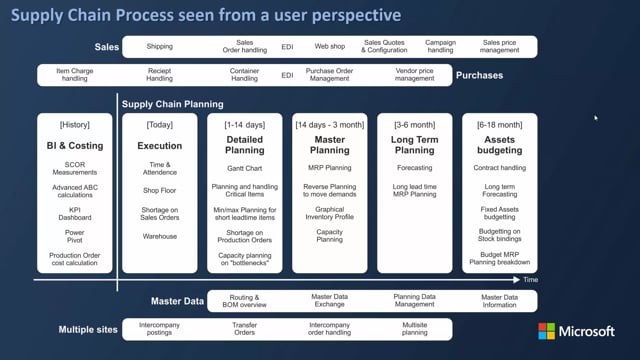


If your company works with supply chain planning, it helps to split the work into different planning horizons. Each horizon covers a different time span and serves a different purpose, and you can assign a responsible person or department to each one.
The three main horizons are long-term planning, master planning, and detailed planning. Long-term planning typically runs from 3 to 18 months ahead. Master planning covers roughly 2 weeks to 3 months ahead. Detailed planning usually spans 1 to 14 days. For each horizon you should decide whether you actually do it, and if so, who is responsible.
Long-term planning: 3 to 18 months ahead
Long-term planning is sometimes called budgeting or asset planning, and it usually covers a span from around 3 months out to 18 months. The point is to break down the requirements for purchase items that have long lead times. If an item takes months to arrive, you need to plan for it well in advance, so this horizon helps you figure out how to handle those purchases in good time.
Master planning: 2 weeks to 3 months ahead
Master planning typically covers from about 2 weeks ahead to 3 months ahead. This is where you do your MRP planning. You work out your capacity needs and your material requirements, take all your capacities into account, and make sure your production orders are lined up and ready. The goal is to plan for the longer period ahead so nothing catches you off guard.
Detailed planning: 1 to 14 days ahead
Detailed planning is the short horizon, typically from 1 to 14 days, or whatever fits your company. Here you work with Gantt charts and graphical views to decide which production orders to start. You also make sure to get confirmation on your purchase orders so you know they will arrive on time.
Execution, history, and reporting
Beyond the three planning horizons, you also have execution, plus history and reporting on your supply chain. These give you the record of what actually happened and let you follow up.
Assigning responsibility for each planning horizon
Once you have divided your planning into these areas, the key question is who owns each one. Is the purchasing department responsible for long-term planning, or someone else? Who handles master planning and detailed planning? By splitting the work into small, clearly defined areas, everybody knows who is in charge of what.
Q&A
What are the three main planning horizons in supply chain planning?
The three main horizons are long-term planning (3 to 18 months ahead), master planning (2 weeks to 3 months ahead), and detailed planning (1 to 14 days ahead).
What is the purpose of long-term planning?
Long-term planning, sometimes called budgeting, covers roughly 3 to 18 months ahead. Its purpose is to break down the requirements for purchase items that have long lead times, so you can plan those purchases well in advance.
What happens during master planning?
During master planning you do MRP planning. You work out your capacity needs and material requirements, take all your capacities into account, and line up your production orders so they are ready.
What does detailed planning involve?
Detailed planning covers 1 to 14 days ahead. You use Gantt charts and graphical views to decide which production orders to start, and you confirm that purchase orders will arrive on time.
Why should you divide planning into separate horizons?
Dividing planning into long-term, master, and detailed horizons lets you assign a responsible person or department to each area. That way everybody knows who is in charge of what.