
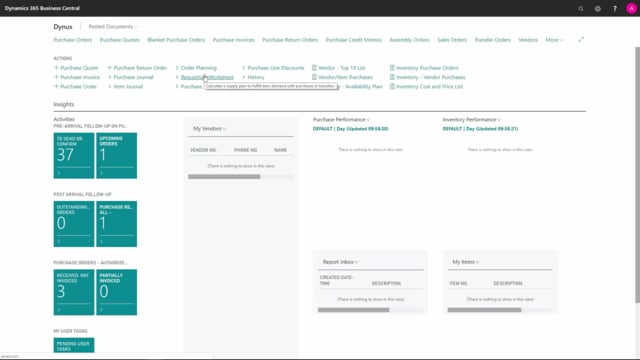


Demand forecasting in Microsoft Dynamics 365 Business Central lets you plan supply before actual orders arrive. As a purchaser working in the requisition or planning worksheet, you can create forecasts that drive purchase order suggestions to send to your vendors.
The key distinction you need to understand is between sales forecasts and component forecasts. A sales forecast is consumed by sales orders. A component forecast is consumed by production order component lines. If you sell an item that you have only forecasted as a component, the system will not reduce that forecast, and you will need to create a sales forecast for it as well.
If you both produce and sell the same item, such as a rim, you must set up both a sales forecast and a component forecast. You then get the combined demand from both forecast types.
How demand forecasting drives the requisition worksheet
When you are responsible for planning, you typically work in the requisition worksheet or the planning worksheet. The purpose is to create supply: the system generates purchase order suggestions based on demand, and you turn those into purchase orders for your vendors.
Forecasts are one of the demand sources that feed into this planning. If you use forecasts, you need to know which type you are using and how each type behaves, because the two types are consumed in completely different ways.
The difference between sales forecast and component forecast
You can view the demand forecast per month and look at both sales items and component items at the same time.
A sales forecast is written down (consumed) by sales orders. For example, if you forecast 100 bikes in April and you have a sales order for 90 of them, the forecast leaves a remaining demand of 10. Bikes are sales items, so they are forecasted as a sales forecast and consumed by sales orders.
A component forecast is written down by production order component lines. Items like rims and spokes, when they are used in production, are forecasted as a component forecast. They are consumed when production orders create demand for them as components, not when they are sold.
Setting up both forecast types for the same item
The challenge appears when you sell an item that you also use as a component. If you sell rims and spokes directly, a component forecast will not be reduced by those sales. The component forecast is only consumed by production order component lines. To cover the sales demand, you must also create a sales forecast for the same item.
For example, you might forecast 160 rims going into production and 100 rims going into sales. When you view both types together, you see a total of 260 on forecast. The 160 will be consumed by production order component lines, and the 100 will be consumed by sales order lines.
These two parts work independently. If you have no production orders but 300 pieces on sales order, the component forecast still leaves a demand of 160 pieces, because the component demand is only consumed by production order component lines, not by sales orders.
What this means for your planning
You have to be aware of how you use demand forecasting before it flows into your requisition worksheet. Choosing the wrong forecast type, or forgetting that an item is both produced and sold, can leave you with demand the system never reduces or demand that disappears unexpectedly. Decide for each item whether it needs a sales forecast, a component forecast, or both, and set up your forecasts accordingly.
Q&A
What is the difference between a sales forecast and a component forecast in Business Central?
A sales forecast is consumed by sales orders. A component forecast is consumed by production order component lines. The two forecast types are reduced by different demand sources, so you need to choose the correct type for each item.
When do I need to set up both a sales forecast and a component forecast for the same item?
You need both when you sell an item that you also use as a component in production. The component forecast is only consumed by production order component lines and will not be reduced by sales. To cover the sales demand, you must also create a sales forecast for that item.
How does a sales order affect a forecast?
A sales order writes down a sales forecast. If you forecast 100 units and have a sales order for 90, the remaining forecast demand is 10. A sales order does not reduce a component forecast.
What happens to a component forecast if I only have sales orders and no production orders?
The component forecast remains as demand. For example, if you forecast 160 pieces as a component and have 300 pieces on sales order but no production orders, the component forecast still creates a demand of 160 pieces, because component demand is only consumed by production order component lines.
How does demand forecasting connect to the requisition worksheet?
Forecasts are a demand source that feeds into the requisition or planning worksheet. The worksheet uses that demand to generate purchase order suggestions, which you turn into purchase orders for your vendors.