
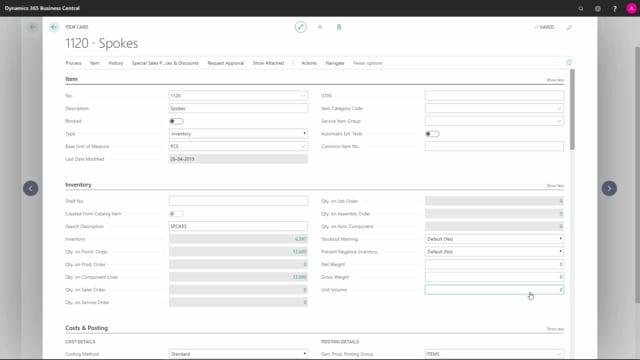


If you use the requisition worksheet in Business Central for purchase planning, you set up the planning parameters directly on the item card. The two key areas are the Replenishment tab and the Planning tab.
On the Replenishment tab, set the replenishment system to Purchase, then fill in the lead time calculation, the vendor number, and the vendor item number.
On the Planning tab, choose a reordering policy. Fixed Reorder Quantity uses reorder point, reorder quantity, and safety stock. Lot-for-Lot bundles demand and requires you to set a safety stock quantity, a lot accumulation period, and a rescheduling period.
The lot accumulation period is the timeframe across which you bundle demands together. The rescheduling period is the timeframe within which you allow changes to an existing purchase order.
Setting up simple planning parameters on the item card
As a purchaser working with Business Central, you can set up simple planning parameters on the item card when you want to use the requisition worksheet. There is also a more advanced area of planning with more detailed parameters, but the parameters described here cover the simple setup that gets you up and running.
Everything starts on the item card, and there are two tabs to fill in: the Replenishment tab and the Planning tab.
Filling in the Replenishment tab
On the Replenishment tab, start by setting the replenishment system to Purchase, since this item is supplied by a vendor.
Then fill in the following:
- Lead time calculation – the time it takes to get the item from the vendor.
- Vendor number – the vendor you buy the item from.
- Vendor item number – if you have one.
That is all you need on the replenishment side.
Filling in the Planning tab with a fixed reorder quantity
On the Planning tab, choose your reordering policy. For a simple setup you can use Fixed Reorder Quantity, which works with minimum and maximum inventory levels.
With this policy, fill in the reorder parameters:
- Reorder point – the inventory level that triggers a new order.
- Reorder quantity – how many you want to order.
- Safety stock quantity – the buffer you normally want to keep.
You can also use the order modifiers, meaning the minimum order quantity and the order multiple, if you work with those.
Using Lot-for-Lot as a reordering policy
If you use Lot-for-Lot instead, you need to fill in at least the safety stock quantity. You would normally also include inventory, so that the planning does not ignore items that already exist in your stock.
Two additional settings matter with Lot-for-Lot, and both are entered as date formulas, for instance one month:
- Lot accumulation period – the period you look across when bundling demands together.
- Rescheduling period – the period within which you want to be able to change an existing purchase order.
Running the requisition worksheet
Once you have filled in these parameters on the item card, you are ready to run requisition worksheet planning. This is the MRP planning that you carry out from the requisition worksheet.
Q&A
Which two tabs on the item card hold the planning parameters for the requisition worksheet?
The Replenishment tab and the Planning tab. The Replenishment tab covers how you supply the item, and the Planning tab covers the reordering policy and parameters.
What do you fill in on the Replenishment tab for a purchased item?
Set the replenishment system to Purchase, then fill in the lead time calculation, the vendor number, and the vendor item number if you have it.
What is the difference between the lot accumulation period and the rescheduling period?
The lot accumulation period is the period you look across when bundling demands together. The rescheduling period is the period within which you want to be able to change an existing purchase order. Both are entered as date formulas, such as one month.
What parameters does the Fixed Reorder Quantity policy use?
It uses minimum and maximum inventory levels through the reorder point, the reorder quantity, and the safety stock quantity. You can also apply order modifiers such as a minimum order quantity and an order multiple.
What should you fill in when using Lot-for-Lot?
Fill in at least the safety stock quantity, the lot accumulation period, and the rescheduling period. You should normally also include inventory so the planning does not ignore items already in stock.