
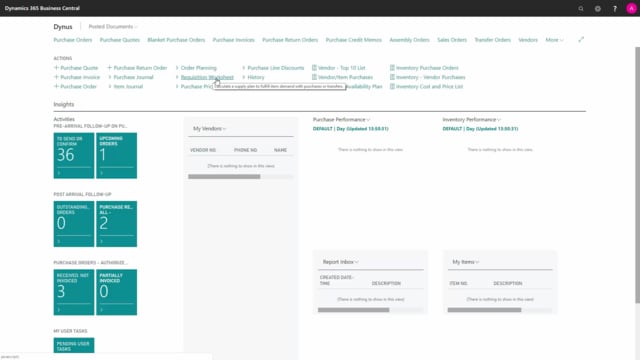


The requisition worksheet in Microsoft Dynamics 365 Business Central lets you do purchase planning. You can generate purchase orders from demand sources like sales orders, production order components, transfer orders, and forecasts. You can also plan based on simple min/max quantities, where the system suggests a purchase when inventory drops below a defined level.
To run the planning, open the requisition worksheet, choose Calculate Plan, and set filters for the starting date, ending date, item number, and location. When you carry out the action messages, Business Central creates the purchase orders for you.
The requisition worksheet only looks at direct demand. It does not break down bills of material in hierarchies. If you need that, use the planning worksheet, which is built for production planning.
What the requisition worksheet does
As a purchase planner, you use the requisition worksheet to handle purchase planning. The worksheet pulls demand from several sources to decide what needs to be purchased. These sources include sales orders, production order component lines, transfer orders, and forecasts.
You also have a simpler option. If you set up a min/max quantity on an item, the system plans a purchase whenever the inventory falls below the level you defined. This is useful when you do not need the full demand-driven calculation.
Running Calculate Plan in the requisition worksheet
When you open the requisition worksheet, you start the planning by choosing Process and then Calculate Plan. The calculation can be simple or very complex, depending on how you set it up. It uses the same MRP planning engine that runs elsewhere in the system.
Before the calculation runs, you set a few filters to keep things manageable:
- Starting date and ending date for the period you want to plan.
- Item number filters if you only want to plan for specific items.
- Location code if you only want to plan for one location. The planning always runs per location, but you can limit it to a single one here.
When you press OK, the system creates a straightforward MRP plan. It takes the demands from sales orders, production orders, forecasts, and transfer orders, and accounts for them in the planning result.
Direct demand only: the limitation to know about
The requisition worksheet looks at direct demand only. It does not break down bills of material in hierarchies. If a demand comes from a finished item that consists of several components, the worksheet will not explode that structure for you.
For that kind of multi-level breakdown, you need the planning worksheet, which is designed for production planning. The requisition worksheet is the right tool when you are planning purchases against direct demand.
Turning the plan into purchase orders
Once the plan is calculated, you review the suggested lines. To turn them into actual purchase orders, choose Process and then Carry Out Action Messages, and confirm with OK. Business Central then creates the purchase orders based on the planning result.
Q&A
What is the requisition worksheet used for in Business Central?
It is used for purchase planning. It generates suggested purchase orders based on demand from sales orders, production order components, transfer orders, and forecasts, or based on simple min/max inventory levels.
What demand sources does the requisition worksheet take into account?
It accounts for sales orders, production orders, forecasts, and transfer orders. It looks at these as direct demand.
Does the requisition worksheet break down bills of material?
No. The requisition worksheet only looks at direct demand and does not break down bills of material in hierarchies. For that, use the planning worksheet, which is built for production planning.
Which filters can you set when calculating the plan?
You set a starting date and ending date for the planning period, item number filters, and a location code if you want to plan for a single location. Planning always runs per location.
How do you create purchase orders from the requisition worksheet?
After calculating the plan, choose Process and then Carry Out Action Messages, and confirm with OK. The system then creates the purchase orders.